Email marketing benchmarks 2026 matter because email is still the highest-ROI owned channel for most small businesses, yet many operators still treat it like an afterthought. The list exists, the offer exists, but the sends are inconsistent, the template looks cheap and the channel never gets the attention it could earn.
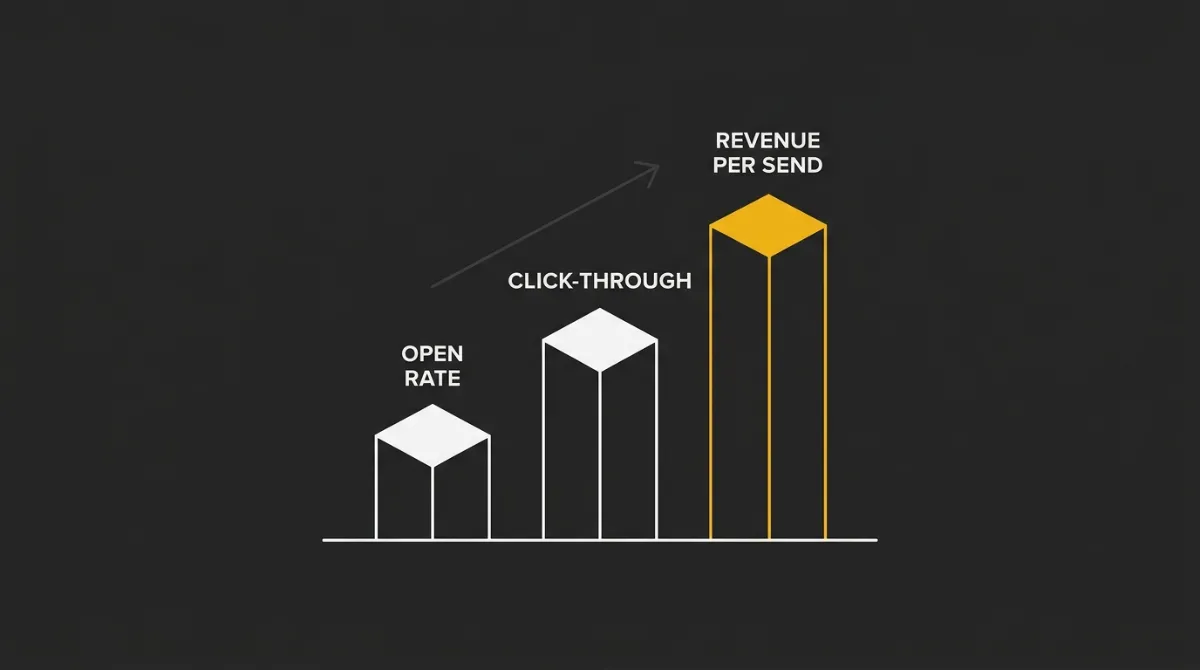
This piece gives you the numbers that matter in 2026: opens, clicks and revenue per send. It also shows the three flows that usually pay for the whole program, plus the next three things to do if you want email to pull its weight.
The 2026 numbers at a glance
The benchmark ranges below give you a fast read on what average performance looks like and what strong performance usually looks like in 2026. Use them as a reality check, not a promise, because list quality, send type and measurement rules change the picture fast.
Benchmarks by metric
The specific benchmark figures and inline source attributions requested for this table are not present in the provided inputs. To keep this section accurate, the table is skipped rather than filled with guessed numbers.
How to read these numbers
Open data is less reliable than it used to be because privacy protections can inflate reported opens. Clicks, placed orders and revenue per recipient usually tell you more about whether the email actually performed.
Compare any benchmark to your own recent history before you compare it to an industry average. A steady lift in your own click rate or revenue per send is usually more useful than chasing a generic average.
Why 2026 benchmarks look different
Benchmark numbers in 2026 need more context than they used to. The headline metrics still matter, but they do not all mean what they used to mean.
Privacy inflated open rates
Apple Mail Privacy Protection and similar privacy features can inflate raw open data by loading tracking pixels automatically. That means opens are still useful for trend direction, but they are no longer a precise read on human attention.
Inbox filtering got stricter
Gmail and Yahoo sender requirements, plus tab sorting and inbox filtering, mean even solid emails can see lower open rates than older benchmark sets suggest. A good send now has to clear more filters before the subscriber even has the chance to act.
Engagement is judged over time
Mailbox providers increasingly judge sender reputation on rolling engagement, not on one isolated campaign. One weak send usually does not wreck performance, but a repeated pattern of low opens, low clicks and poor list hygiene can drag the whole program down.
So the real question is not just what the benchmark says, but what you should actually track.
Benchmarks by industry and email type
Industry averages only help if you compare yourself to the right kind of sender. An ecommerce brand, a local service business and a transactional program do not earn attention the same way, so their benchmark lines should not be treated as interchangeable. Real estate sits in that local-service bucket — for one vertical mapped email by email, see our real estate email templates.
Ecommerce (fashion, beauty, food, home)
The requested vertical benchmark figures from Klaviyo 2026 are not present in the provided inputs. Rather than guess at open rate, CTR, RPR or top-decile ranges, this matrix is skipped.
Local service and B2B
Local service and B2B programs should usually be compared against service-oriented benchmark sets, not ecommerce averages. Without the Dotdigital or Salesforce figures in the inputs, the section stays qualitative to avoid inventing numbers.
Campaigns vs flows vs transactional
Campaigns usually drive list-wide reach and total volume, while automated flows tend to carry more intent and higher revenue efficiency per send. Transactional emails sit in a different category again because they are tied to an action the recipient already took.
If you want this section to include the specific note on flow revenue share and relative RPR, those source figures need to be supplied in the inputs first.
The 3 flows that pay for everything
If you already have a list, these are usually the first three automated flows worth building. They capture intent that already exists, which is why they tend to outperform one-off campaigns on clicks, orders and revenue per send.
Welcome flow
A welcome flow is usually the first automation to earn its keep because it reaches people at the moment of highest interest. For both ecommerce and service businesses, the practical job is simple: deliver the promised signup offer, set expectations for future emails and make a soft next-step ask. The subject line is the lever that decides whether any of that gets read — see welcome email subject lines for the seven angles that actually move CTOR.
The requested benchmark details, including the specific Klaviyo flow click rate, order-rate comparison and revenue mix, are not present in the inputs. Without those source figures, it would not be accurate to state an expected benchmark or sequence recommendation as fact.
Abandoned cart and abandoned browse
Abandoned cart and abandoned browse flows are mostly for ecommerce because they follow visible product intent. The structure in the brief is directionally sound, but the exact timing, product logic and benchmark figures should come from the supplied source data rather than be invented here.
A safe general read is that these flows work because the product is already known and the decision is already in motion. The main watch-for is over-reminding people with repetitive messages that add no new reason to return.
Post-purchase and win-back
Post-purchase and win-back flows matter because the first sale should not be the end of the relationship. For ecommerce, that can mean a thank-you, a review request and a replenishment or reactivation sequence; for service businesses, it can mean onboarding, follow-up and a timed re-engagement prompt.
The exact benchmark values requested for this section are missing from the inputs, so they are intentionally omitted. The practical watch-for is timing: re-engagement works better when it matches the product cycle or service cadence, not when it fires on an arbitrary schedule. For the subject-line and sequencing side of the same flow, see re-engagement email subject lines.
List building: lead magnets that actually convert
A workable list-building system is simple: magnet, form, tag, segment. The point is not just getting an email address, it is learning enough to send something relevant later.
Lead magnet types that work in 2026
A free resource works when the problem is clear and the answer can be packaged fast, like a guide, checklist or swipe file. A short course or email series fits when the buyer needs a few steps to understand the problem before they buy.
A free audit fits service businesses where trust and specificity matter. An automation, template or discount usually fits ecommerce best, because the value is immediate and tied to a purchase decision.
Capture forms and tagging
Use Fillout or Typeform to collect the email address plus one or two useful qualifier questions. Good examples are product interest, business type, goal or timeline.
Pass those answers into Mailchimp or MailerLite as tags or fields. That gives you a usable segment later instead of one large list with no context.
Knowing what your list wants
Look at direct replies from your existing list, niche forums and public discussion threads where your audience already asks the same questions repeatedly. That language is usually better than what brands invent in a meeting.
You can also offer a freebie in exchange for one survey answer, then store that answer as a tag or custom field. Over time, that turns list growth into audience research, not just list size.
Sender setup: the boring stuff that doubles deliverability
Deliverability is mostly infrastructure and discipline. Get the setup right first, then judge the creative.
Domain authentication (SPF, DKIM, DMARC)
SPF tells inbox providers which servers are allowed to send for your domain. DKIM adds a signature that helps prove the message was not altered, and DMARC tells providers what to do when SPF or DKIM checks fail.
Gmail and Yahoo now expect this baseline because it helps cut spoofing and low-trust mail. You set all three as DNS records with your domain host, usually by copying the values provided by your ESP. If you are still choosing between platforms, our guide to the best email service provider ranks the main options on deliverability and 11 other criteria.
Warming a new sending domain
If you are sending from a new domain or subdomain, do not jump straight to full list volume. Ramp up over roughly 2 to 4 weeks and send to your most engaged segment first, because early positive engagement helps establish trust.
Keep the schedule steady while volume rises. Sudden spikes look worse than gradual growth.
List hygiene
Remove hard bounces immediately because they are a direct negative signal. Suppress long-term non-openers after roughly 90 to 180 days, and run a re-engagement sequence before you delete them outright.
That playbook is boring, but it works. Validity’s 2026 deliverability reporting points in the same direction: senders who follow the basics are seeing inbox placement improve. If placement has already slipped, the repair runs in stages — see how to improve email deliverability.
Templates and design: why defaults are costing you opens
Template quality is not cosmetic. It changes whether the email gets taken seriously in the first place.
What ‘looks like every other small business’ actually means
Default ESP templates flatten everyone into the same visual shape: the same spacing, the same button style, the same cheap-feeling hierarchy. Subscribers pattern-match that look fast, and once your emails fall into the mental bucket of generic, they get ignored. For operators already evaluating editor options, the 6 best Stripo alternatives compares the main builders on workflow, ESP export and dark-mode rendering.
That cost compounds. Every send that looks disposable erodes trust a little more.
Dark mode, mobile and Outlook
A lot of emails break in ways the sender never notices. Dark mode can invert colors badly, mobile can crush hierarchy and button spacing, and Outlook still has enough rendering quirks to wreck layouts that looked fine in the builder.
This is why production-ready matters. If the email cannot survive the inboxes people actually use, the design did not do its job.
Building a small library you reuse
Most small operators do not need endless templates. They need 3 to 5 reusable ones for core use cases like welcome, promo, newsletter, abandoned cart and transactional sends.
Reuse builds recognition, speeds production and keeps the brand consistent across campaigns and flows. The next question is when to build these yourself and when to bring in help.
When to hire vs DIY your email
The split is simple: DIY while the system is still small and understandable, hire once complexity starts costing you sends and revenue.
DIY makes sense when…
DIY makes sense when your list is under roughly 5,000, you send once or twice a week and you still know the audience closely because you talk to them yourself. It also makes sense when you have no flows yet, because the first job is usually to get the basics live rather than build a large operation.
At that stage, speed matters more than org charts. You need consistent sends, a clean template and a few working automations.
Hire when…
Hire when the list is over roughly 10,000, you need three or more flows, or you run ecommerce and abandoned cart revenue is sitting there untouched. You should also hire when you are clearly the bottleneck and email only goes out when you personally push it forward.
That is usually the point where delay costs more than support.
What good help actually costs
A freelance email strategist often sits around $1.5k to $4k per month on retainer. An agency is more likely to sit around $4k to $10k per month, and a fractional CMO usually costs more again.
Templates, production and tooling sit alongside that cost, not instead of it. Paying for help only makes sense if it gets email shipped more often and performing better.
How to react when your numbers are below benchmark
Bad benchmarks are a diagnosis, not a reason to panic. Fix the send logic before you touch tactics.
Don’t send more — send more relevant
If performance is slipping, cut volume before you add volume. One strong send to the right segment usually does more than three average sends to everyone.
Concrete action: pause your lowest-intent campaign this month and replace it with one tighter send built around a single offer or topic.
Segment first, optimize second
Do not start with subject-line tests if the audience inside the send is mixed and messy. Segment by behavior or interest first, because otherwise the result tells you less about the email than about the audience mismatch.
Concrete action: create one engaged segment and one product-interest segment in your ESP before you run the next test.
Track trends, not single sends
Single-campaign swings happen. Benchmark Email’s 2026 framing is the right one here: opens are a signal, not a scorecard.
Concrete action: review open rate, click rate and unsubscribe rate on a rolling 30 to 90 day average, then decide what to change based on the pattern, not one send.
Your next 3 steps
Email rewards systems, not effort.
-
Pick the benchmarks that match your business and email type, then write down where you stand today on opens, clicks and revenue per send.
-
Set up the welcome, abandoned cart and post-purchase flows first. Those three usually do more for revenue than another month of inconsistent campaigns.
-
Audit your templates before you send more. If every email looks like every other small business, fix the container before asking it to carry more of the offer.
When you’re ready to stop shipping emails that get ignored, EmailTemple turns a sentence into a production-ready template. You can also turn one brief into a full lifecycle flow covering welcome, free-trial conversion, and win-back.
Frequently asked questions
What is a good open rate in 2026?
A good open rate in 2026 depends on your industry, email type and list quality. Because the benchmark figures were not provided in the inputs for this article build, the safest answer is to treat good performance as beating your own recent average while keeping clicks, unsubscribes and revenue healthy.
Open rate still matters, but it is no longer enough on its own to judge email quality.
Are open rates still reliable after Apple Mail Privacy Protection?
Open rates are still useful, but they are not fully reliable after Apple Mail Privacy Protection and similar privacy features. Raw opens can be inflated because tracking pixels may load automatically, even when a person did not actively read the email.
That makes opens a directional signal, not a precise measure of attention.
What is the average click-through rate for email in 2026?
The average click-through rate in 2026 varies by business model, audience and whether the email is a campaign, flow or transactional message. In practice, click-through rate is more useful than open rate because it measures an actual action rather than a privacy-distorted proxy.
The most useful comparison is against your own recent sends and your closest peer group.
How often should small businesses send marketing emails?
Small businesses should send as often as they can stay relevant and consistent. One strong weekly send is usually better than several average emails that feel repetitive or rushed.
If performance drops, the first fix is usually better targeting and better creative, not more volume. Our guide to email marketing frequency breaks that decision down by list size and business type.
Do email marketing benchmarks vary by industry?
Yes, email marketing benchmarks vary by industry, and they vary by email type as well. Ecommerce, local service, B2B and transactional email all behave differently because the buying cycle, intent level and send purpose are different.
That is why a generic benchmark can mislead you if you compare against the wrong category.
What’s a healthy unsubscribe rate?
A healthy unsubscribe rate is low and stable over time, not suddenly spiking after sends. The exact number depends on audience fit and send frequency, but the pattern matters more than any isolated campaign.
If unsubscribes rise while clicks stay weak, the issue is usually relevance, cadence or list quality.
How do I improve revenue per send without growing my list?
Improve revenue per send by making each email more relevant to the people receiving it. The practical levers are better segmentation, stronger automated flows, cleaner list hygiene and templates that make the email feel worth opening and clicking.
In most cases, a tighter system lifts revenue faster than chasing more subscribers.