You have a list. You’re not sending to it. That’s the expensive part.
You are probably a small business owner with a real list, or at least a pile of customer addresses, and you have not sent anything in months. Now you are searching cost comparison direct mail vs email marketing because direct mail feels tangible, while email feels cheaper but harder to get right without looking amateur.
That hesitation has a cost. Every quiet month is another month where revenue per send stays at zero, not because the list is bad, but because nothing went out, and the next section will show the per-send math behind that tradeoff.
The actual cost per send, side by side
For a small business comparing channels, the fastest useful answer is this: direct mail usually costs materially more per contact than email, while email’s cost is mostly tied to your ESP tier and list size. USPS and DMA-style industry guidance commonly frames direct mail in per-piece terms, while email is usually priced as a monthly platform cost spread across however many sends you make.
| Channel | Cost per contact | Setup cost | Speed to launch | Best list size | Where the cost lives |
|---|---|---|---|---|---|
| Direct mail postcard (EDDM) | $0.35 to $2.00 per piece | Printing, design, mailing prep | Slower, depends on print and postal timelines | Broad local coverage | Every mailed piece, plus production |
| Direct mail letter (targeted) | $0.35 to $2.00 per piece | Printing, envelopes, design, list prep | Slower, depends on production and delivery | Smaller, more targeted lists | Every mailed piece, plus creative and list work |
| Email via ESP (Mailchimp/MailerLite tier) | $0.003 to $0.05 per send | $50 to $270 per month at common list sizes | Fast, once the platform and template are ready | Small to very large owned lists | Monthly software cost spread across sends |
| Email direct (sending one-by-one from inbox) | Low visible cash cost, but high labor cost per message | Mostly staff time | Fast for a few contacts, poor for repeat campaigns | Very small lists only | Manual time, inconsistency, and missed scale |
What direct mail costs per piece
USPS and DMA-style cost framing usually starts with the mail piece itself. That means each postcard or letter carries a per-piece cost, then design, printing, list prep, and postage stack on top.
The practical range in the inputs is $0.35 to $2.00 per piece. Where you land inside that range depends on format, targeting, print choices, and how much production work you need before anything goes out.
What email marketing costs per send
Email usually looks cheaper on a per-send basis because the main cost sits in the software tier, then gets divided across your campaigns. In the inputs here, that works out to about $0.003 to $0.05 per email send, with common ESP costs around $50 to $270 per month depending on list size.
That is why sending more often can improve the economics of email, assuming the list is permission-based and the sends are worth opening. The fixed platform cost gets spread across more campaigns instead of sitting idle.
The 600x gap and what closes it
A $1.50 mail piece is roughly 600 times the cost of a $0.0025 email send, and still far more expensive than many sends even at the higher end of normal ESP math. That is the blunt cost difference most operators need to see first.
What closes that gap is not mystery, it is response rate and deal size. If a mailed piece reliably produces larger orders, higher-value appointments, or better response from a narrow local audience, the higher unit cost can make sense, but if both channels are reaching people who already know your business, email usually wins on cost efficiency fast.
If you’re sending to under 500 contacts, send direct from your inbox
If your list is small, warm, and made up of people who already know you, sending from your regular inbox can be the cheapest sensible option. The point is not sophistication, it is getting the send out without paying for software you are not using enough yet.
Service business with under 200 past clients
Fits an owner-operator who wants to send occasional updates, reminders, or seasonal offers to people they have already worked with.
Monthly cost is near zero beyond the inbox they already pay for, which makes ESP overhead wasted spend if sends are infrequent.
Trust risk: bulk sends from Gmail can trip filters as volume rises, and BCC starts to look sloppy fast. Honest limit: poor tracking and weak repeatability once sending becomes a real channel.
Local operator emailing 50-300 known contacts monthly
Fits a local business owner sending monthly notes to regular customers, referrals, or community contacts who would recognize the sender name immediately.
Monthly cost stays near zero, which is often the right call when the audience is small and the message is simple.
Trust risk: once you push larger recipient batches, inbox providers may treat it like bulk mail, and BCC feels impersonal. Honest limit: formatting, consistency, and list management get messy quickly.
B2B founder doing personal outreach to a warm list under 500
Fits a founder writing plain-text style updates or offers to prospects, former leads, or customers who already know the business.
Monthly cost is still near zero if the founder is sending carefully from an existing inbox instead of buying software too early.
Trust risk: sending to too many recipients at once can hurt deliverability, and visible mass-sending habits reduce the personal feel. Honest limit: it stops scaling when cadence, segmentation, or reporting starts to matter.
When direct sending makes sense
Direct inbox sending makes sense when the audience is warm, the list is small, and the message can feel personal. It works best when people already know your name and would not be surprised to hear from you.
In that case, the cheapest path is often the right one. If you only send occasionally, buying software before you have a real sending habit can be unnecessary overhead.
Spam, deliverability and the trust trade-off
The trade-off is simple: inbox sending is cheap, but it is not built for bulk campaigns. Once you start sending larger batches from Gmail or a similar inbox, filters can get stricter and the message can look less personal at the same time.
BCC also creates a trust problem. It hides recipients, but it can feel blunt and unpolished, which matters if your business depends on familiarity and credibility.
Where it breaks
This approach breaks when sending becomes a repeatable channel instead of occasional outreach. The moment you need segmentation, templates, unsubscribe handling, reporting, or reliable volume, the inbox stops being enough.
Above this volume, you need software.
Above 500 contacts, software pays for itself in the first send
Once your list is large enough that inbox sending becomes risky, the decision stops being about software overhead and starts being about deliverability. At that point, the monthly cost of an ESP is usually small compared with the cost of emails that never reach the inbox.
| MailerLite | Mailchimp | ActiveCampaign | Sending direct from Gmail/Outlook | |
|---|---|---|---|---|
| Monthly cost at 1k contacts | About $50 to $62 | About $50 to $62 | About $50 to $62 | Near zero visible software cost |
| Monthly cost at 5k | About $62 | About $62 | About $62 | Near zero visible software cost |
| Monthly cost at 25k | Between common mid-tier and higher-volume pricing anchors | Between common mid-tier and higher-volume pricing anchors | Between common mid-tier and higher-volume pricing anchors | Not practical at this scale |
| Free tier limit | Varies by provider plan and current offer | Varies by provider plan and current offer | Usually limited or not the main fit | No true campaign tier, just mailbox limits |
| Deliverability infrastructure included | ✓ | ✓ | ✓ | ✗ |
| Authentication (SPF/DKIM/DMARC) handled | ✓ | ✓ | ✓ | ✗ |
| Best for | Small businesses that want lower-cost campaign sending | Businesses that want a familiar mainstream ESP | Operators who expect to outgrow basic sending | Very small, warm, manual outreach only |
What an ESP actually costs at 1k, 5k, 25k contacts
The pricing anchors in the inputs are straightforward: about $62 per month around 5,000 contacts, about $100 around 10,000, and about $270 around 50,000. That means the software cost rises with list size, but still stays far below the cost of printing and mailing physical pieces to the same audience.
At 1,000 contacts, the practical takeaway is not the exact provider delta, it is that you are paying for infrastructure, not just a sending button. At 25,000 contacts, the monthly bill is real, but still predictable in a way inbox workarounds are not.
Deliverability, spam scores and why direct sending fails at scale
Direct sending fails at scale because inbox tools were built for person-to-person email, not campaign volume. Gmail’s common daily cap is around 500 recipients on standard accounts, and once your sending pattern looks promotional, spam filtering risk goes up fast.
The more expensive failure is not the subscription fee you avoided. It is the campaign that lands in spam and earns nothing.
Mailchimp vs MailerLite vs ActiveCampaign at the entry tier
At the entry tier, the meaningful comparison is less about advanced features and more about whether the platform gives you reliable campaign infrastructure at a monthly cost you can tolerate. For this section’s purpose, all three sit in the same category: they are paid tools that make scaled sending legitimate in a way direct inbox use is not.
If you are still under a few hundred warm contacts, direct sending can be fine. Once you are above that, even a modest ESP bill tends to pay for itself because inbox placement matters more than the line item.
When direct mail is worth the 600x premium (and when it isn’t)
Here is the simple rule: under a $5K average deal size, direct mail rarely pencils out on pure response economics. At $1.50 per mail piece and a 4.4% response rate, you are paying about $34 per response, while email at $0.003 per send and a 0.12% response rate lands closer to $2.50 per response.
Direct mail still has a place when the audience does not know you yet. It can make sense for cold outreach, some regulated categories, local geo-targeting through EDDM, and high-ticket B2B where a single closed deal over $10K can absorb a much higher acquisition cost.
Email wins when you already have permission and attention, even if that attention has gone quiet. If you are sending to past customers, active subscribers, referral relationships, or anyone likely to recognize your name, email usually wins on cost per outcome and speed at the same time.
The strongest play is often sequencing, not choosing one side forever. Mail can open the door with a cold audience, then email follow-up inside 48 hours can do the cheaper repeat work, which lines up with BKM-style lift claims around +53% for coordinated follow-up and with smaller operator observations that combined outreach can beat a single-channel approach.
Real numbers from operators who run both
The cost gap is real, but channel choice still depends on what happened in actual campaigns. These public data points matter because they compare response and sales impact, not just software fees or postage.
Cold email vs handwritten mail B2B test
Public operator comparison discussed in r/b2bmarketing.
200 cold emails compared with 33 handwritten letters plus 2 follow-up emails.
Cold email produced a 3.5% meeting rate, while the handwritten-mail sequence produced 6%.
The smaller, more targeted sequence booked more meetings without requiring a large-volume send.
BKM case data on direct mail lift
Public BKM campaign data.
Ads paired with direct mail, plus a comparison between one mailed prospect touch and two.
Combined ads and direct mail produced about 21% to 44% sales lift, and mailing prospects twice generated a 53% lift over a single send.
Mail gets more interesting when it is repeated or paired with another channel, not when it is treated as a one-off blast.
DMA benchmark on response vs cost
Public DMA benchmark language.
Average direct mail response rates compared with average email response rates, then translated into cost per response.
Direct mail averages about 4.4% response versus about 0.12% for email.
Email still lands around $2.50 per response versus about $34 for mail, which is why small deal sizes usually favor email.
No single number wins. Cost per outcome wins.
The hidden cost nobody quotes: what your email actually looks like
ESP fees are not the real cost of email. The real cost is sends that never get opened, and a $62 per month MailerLite bill is basically irrelevant if the default template makes your brand look like every other small business and leaves you stuck at an 18% open rate.
What changes with a production-ready, dark-mode safe, typographically tuned template is not the software bill. Open rate, click rate, and revenue per send are the numbers that move, which means the same monthly ESP cost can produce materially more from the exact same list when the email looks considered instead of generic.
At 5,000 contacts, moving from an 18% open rate to a 30% open rate puts the offer in front of 600 more people on a single send. The ESP cost did not change, only the container did.
Common questions from operators picking a channel
Is it cheaper to send email direct from Gmail or use Mailchimp?
Yes, sending direct from Gmail is cheaper in visible cash terms when you are emailing a very small group. That usually holds up to about 50 recipients per send, then deliverability risk and BCC etiquette start making the free option more expensive than it looks.
Once you are regularly sending to a few hundred contacts, an ESP is usually cheaper than the trust and inbox placement you lose doing it manually. If you are above 200 to 500 contacts, price an ESP before sending the next campaign.
What’s the smallest list size where ESP software is worth it?
For most small operators, the threshold is around 500 contacts or any situation where email is clearly commercial rather than personal. Below that, direct sending can still work if the list is warm and the cadence is low.
The entry cost can be very small, especially on free or low-tier plans. Start by checking whether your list fits inside a free tier up to 1,000 contacts or a paid plan around $0 to $15 per month.
Will my emails go to spam if I send direct from my inbox?
Yes, often, especially once your sending pattern looks like bulk email instead of normal one-to-one communication. Gmail and Outlook are built for personal or team correspondence, while ESPs are built to support authentication and campaign sending.
That is where SPF, DKIM, and DMARC matter. If you plan to send to more than a small hand-picked group, use a platform that supports those checks before the next send.
Can I run direct mail without spending thousands?
Yes, you can, especially with EDDM postcards. A practical starting point in the inputs is about $0.35 to $0.55 all-in per piece, which puts 500 pieces under roughly $300.
That makes direct mail accessible for a small local test, not just big-budget campaigns. Start with one carrier route and one simple offer before printing more than 500 pieces.
Why does my email open rate drop when I switch ESPs?
Usually, the ESP is not the real problem. More often, the template changed, the email renders badly in dark mode or on mobile, or the overall send starts looking generic enough that the list stops paying attention.
A tired-looking template can drag down opens even if the platform itself is fine. Check the template on mobile and in dark mode before the next send, then compare open rate over 2 campaigns.
Pick the channel. Then make the email earn its open rate.
Once email is part of your mix, the next cost question is not the platform fee. It is whether the send looks strong enough to earn opens, clicks, and revenue per send from the list you already have.
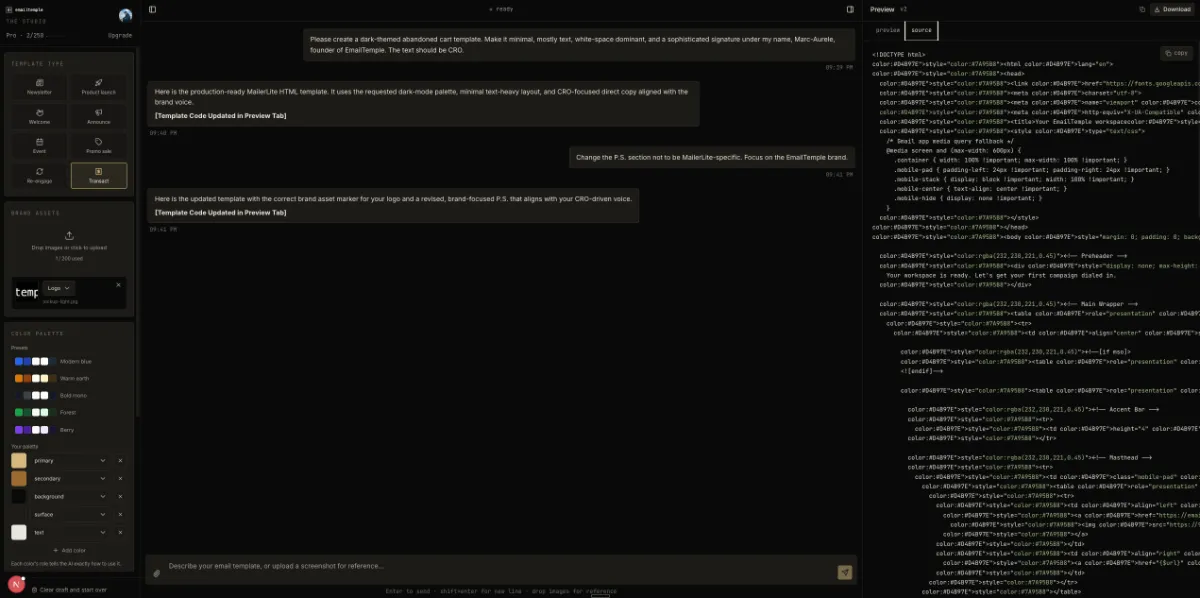
Production-ready in seconds. Designed to be opened.
Once you've decided email is in your mix, the template decides what your ESP fee actually returns.
- Describe the send. The studio returns a production-ready template, typographically tuned, dark-mode safe.
- Export to Mailchimp, MailerLite, or ActiveCampaign in seconds. No drag-and-drop, no template browsing.
- One considered conversation per email. No design contractor, no default-template tax on your open rate.
Built for small businesses with a list and a strong offer