
If you want to know how to grow your email list, start here: you probably already have a list, or you are starting one, and it is not growing or getting used fast enough. That is common for small businesses, especially when list-building only happens occasionally and sending slips behind everything else.
This post covers 40+ practical ways to fix that — from simple in-person asks and site forms to free tools, partnerships, lead magnets and a few weird wins that still work. The goal is not more theory. It is more subscribers you can actually email.
The fastest ways to grow your email list
Start with the channels you already have, then add one clear reason to subscribe and one visible place to do it. Most small businesses do not need more tactics first — they need better placement and a better offer.
The five highest-leverage tactics
- Add a clear sign-up incentive on your site so visitors know exactly what they get for joining.
- Use a fullscreen or exit-intent pop-up to catch people before they leave without subscribing.
- Offer a free tool or lead magnet that solves one small problem fast and earns the email signup.
- Put your sign-up link in your email signature and social bios so every conversation can grow the list.
- Run a giveaway or referral push when you need a short burst of new subscribers and shares.
Pick by where you already spend time
Start where your existing attention already lives: your website, social profiles, inbox, checkout flow, front desk, events or daily client conversations. If people already see you there, that is the fastest place to add an email ask.
Pick one channel, set up one offer, and make the signup impossible to miss.
What counts as an email list, and why yours is an asset
An email list is a permission-based collection of people who gave you their email address so you can contact them directly.
That makes it different from social followers. A platform can change the feed, limit reach or bury your posts — but an email send still goes straight to the inbox you were given permission to use. That direct access is one reason email keeps performing well, and Klaviyo research has found that about 76% of companies rank it among their top three ROI channels.
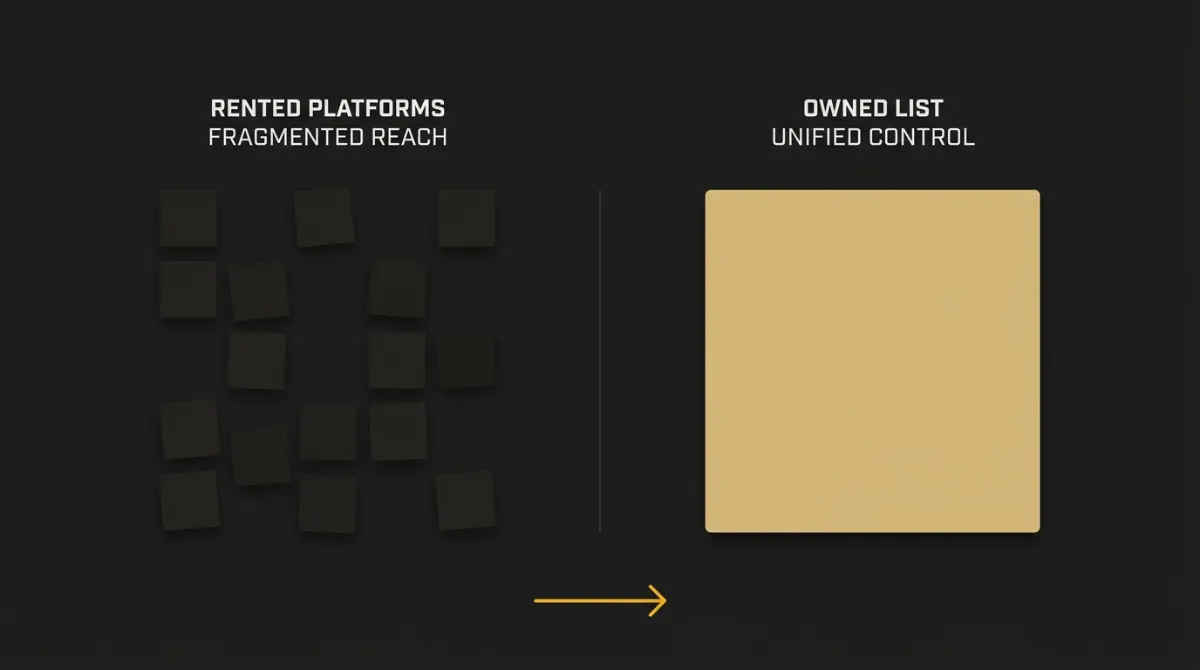
Owned vs rented audiences
Your email list is an owned audience. Your followers on Instagram, TikTok or any other platform are a rented audience because the platform controls what gets seen and when.
What growth actually means
Real list growth is not a bigger raw subscriber count by itself. It is net new engaged subscribers — people joining faster than inactive, bounced or unsubscribed contacts leave, and people who are still likely to open, click and buy.
Simple wins: just ask people for their email
The fastest list-growth tactics are usually the least glamorous. They work because they show up in places where you already talk to people every day.
Add a sign-up link to your email signature
Add one line under your name with a clear reason to join, such as: Get weekly tips and offers here. Link it to your signup page, not your homepage.
Avoid vague copy like Join my newsletter with no context. People need to know what they will get and why it is worth the click.
Put it in every social bio
Your Instagram, LinkedIn, TikTok and YouTube bios should all include the same signup link or landing page. A simple example is: Free weekly updates and offers, join here.
Avoid sending people to a cluttered link page if email signup is the goal. If you use a link hub, make the email option the first item.
Ask in DMs and comment replies
When someone asks for details, pricing, availability or recommendations, reply normally and include your email signup when it fits. Save a short reusable snippet in a TextExpander-style tool so you can paste a clean answer fast.
Avoid dropping the link into every conversation like a bot. It should feel like a relevant next step, not a script sprayed everywhere.
Mention it on calls, podcasts and webinars
If you are already speaking to prospects or audiences live, say the signup out loud before the call ends. For example: I send updates and resources by email, I will drop the link in the chat.
Avoid saving the mention for a rushed final second. Give one clear reason to join, then tell people exactly where to go.
Add it to your invoices and receipts
Invoices, booking confirmations and receipts get opened. Add a short line such as: Want updates, tips and first access to offers? Join here.
Avoid making this the main message on transactional emails or documents. Keep it secondary, clear and easy to ignore if it is not relevant.
Website tactics that capture visitors you already have
If your site already gets traffic, list growth usually comes down to placement, timing and one clear reason to subscribe. These on-site captures work best when the ask matches the page and does not interrupt too early.

Welcome pop-up (first visit)
A welcome pop-up is the first signup ask shown to new visitors. Place it above the page content as a modal after a short delay or light scroll, not the instant the page loads.
A practical tip is to delay it until the visitor has shown some intent. What to watch for: asking too soon, especially on mobile, can feel like a wall instead of an invitation.
Exit-intent pop-up
An exit-intent pop-up appears when a desktop visitor moves toward leaving the page. Place it across high-intent pages such as product, service and pricing pages.
Use a different message than your welcome pop-up, such as a last-chance guide, code or checklist. What to watch for: showing the same offer everywhere can train people to ignore it.
Embedded footer form
A footer form is a permanent signup field built into the bottom section of your site. Place it in the global footer so it appears on every page without interrupting the visit.
Keep it short, usually email address plus one clear benefit line. What to watch for: burying it under generic text and tiny links makes it invisible.
Header / nav “Join the list” link
A header or navigation link gives visitors a constant, low-friction path to subscribe. Place it in the main site nav or utility bar where it stays visible across the site.
Use direct link text like Join the list or Subscribe. What to watch for: hiding it inside a dropdown adds friction for no reason.
Scroll boxes and slide-ins
Scroll boxes and slide-ins appear after someone has engaged with a page for a bit. Place them near the lower corner of blog posts, guides or long-form landing pages after meaningful scroll depth.
A good tip is to trigger on scroll instead of time alone. What to watch for: oversized boxes that cover content can hurt the reading experience.
In-line CTAs inside blog posts
An in-line CTA is a signup prompt placed inside the article itself. Put it after a useful section, near the middle of the post, or right before the conclusion.
Match the offer to the topic the reader is already consuming. What to watch for: dropping the same newsletter pitch into every post without context lowers relevance.
Checkout opt-in checkbox
A checkout opt-in checkbox invites buyers to join your list while completing a purchase. Place it near the email field or order summary, where the customer is already sharing contact details.
Keep the wording specific, such as updates, offers or product news. What to watch for: pre-checking boxes may create low-quality subscribers or compliance issues depending on your setup.
Dedicated /subscribe landing page
A dedicated subscribe page is a focused landing page built for one job only: getting the email signup. Link to it from your bio, email signature, nav, QR codes and social posts.
Include a clear headline, one benefit list and one form. What to watch for: sending traffic to a homepage and hoping people find the signup on their own.
Lead magnets and free resources that earn sign-ups
A lead magnet works when the exchange is obvious: the visitor gives you an email address, and you give them something specific that helps right now. The more concrete the problem and the faster the payoff, the better the signup usually performs.
Ebooks, guides and checklists
These are downloadable resources that teach one focused topic. A good example is a checklist for opening a second location, launching a seasonal promotion or setting up your first welcome email series.
Keep the scope narrow. A 3-page checklist for one job often earns more signups than a broad guide that tries to cover everything.
Templates and swipe files
Templates and swipe files give people something they can copy, edit and use immediately. That can be sales email copy, social captions, proposal templates or even production-ready email templates if your audience needs better sends without starting from scratch.
Make them editable and tied to one use case. Generic template packs tend to get ignored because they ask the reader to do too much sorting.
Free tools and calculators
A free tool solves a small problem on the spot, which makes it one of the strongest signup offers. HubSpot’s Website Grader is a well-known example because it gives immediate feedback instead of promising value later.
If you build one, keep the output useful before the email follow-up arrives. People should feel the tool helped even if they only spend a minute with it.
Mini email courses
A mini email course is a short sequence of lessons delivered over several days. For a small business, that might be a 5-day course on booking more consultations, writing better product emails or improving first-time customer follow-up.
Make each lesson short and practical. If lesson one feels like filler, the rest of the sequence will not earn trust.
Quizzes and assessments
Quizzes help people identify their fit, needs or next step. Andie Swim has shared that its fit quiz generated $70K in revenue, which shows how well this format can work when the result helps someone buy with more confidence.
The key is relevance. Ask only questions that improve the recommendation, then connect the email signup to the personalized result.
Webinars and workshops
A webinar or workshop is a live or recorded teaching session people register for by email. This works well when your business already explains things in sales calls, demos or local events.
Give the session a clear outcome, not just a topic. People are more likely to register for how to fix one problem than for a broad educational talk.
Content upgrades inside blog posts
A content upgrade is a bonus resource tied to the exact article someone is reading. For example, a post about email planning could offer a matching campaign calendar, checklist or worksheet at the midpoint or end of the page.
This works because the offer matches the reader’s current intent. A specific upgrade usually beats a generic newsletter ask because it feels like the next useful step, not a detour.
Sign-up incentives compared: what actually converts
The right signup incentive depends on your margin, your audience and what kind of subscriber you want to attract. Discount-led offers often convert fastest, but they are not always the best fit if you care more about subscriber quality than raw volume.
| Incentive type | Typical use case | Average CVR | Best for | Watch out for |
|---|---|---|---|---|
| Percentage discount | First-purchase signup offers on ecommerce sites | ~43% | Stores with healthy margin and clear first-order conversion path | Can attract discount-only subscribers |
| Dollar-off coupon | Cart-building offers with a fixed savings amount | varies | Brands with predictable average order values | Can erode margin on lower-priced items |
| Free shipping | Checkout-focused or product-page opt-ins | ~1% | Brands where shipping cost is the main buying objection | Often weaker than percentage-off offers |
| Giveaway / contest entry | Short-term list growth campaigns and launches | ~11% | Fast list building and social sharing | May bring in low-intent subscribers |
| Free sample or gift-with-purchase | Product-led signup offers for physical goods | varies | Beauty, food, wellness and repeat-purchase brands | Fulfillment cost can rise fast |
| Lead magnet (ebook / template) | Service businesses, creators and B2B capture | varies | Businesses selling expertise or repeat education | Generic topics usually convert poorly |
| Quiz result | Fit finders, product matching and assessments | varies | Brands with multiple offers, styles or buyer paths | Too many questions can kill completions |
| Early access / VIP list | Product drops, launches and limited-capacity offers | ~25% | Brands with launches, waitlists or seasonal demand | Needs a real reason to join now |
Social media tactics for growing your email list
Social followers are useful, but they are still rented attention. The job is to turn platform reach into email subscribers you can contact directly later.
Instagram: bio link, Stories, link stickers, carousels
On Instagram, the bio link is the highest-leverage placement because it stays visible across every post and profile visit. Brands like Sanzo have used direct bio CTAs to push followers toward owned channels instead of hoping people keep seeing feed content.
Use Stories and link stickers to support the same offer repeatedly. A practical tip is to make your carousel teach one useful thing, then point the final slide to the signup link for the full resource.
LinkedIn: profile header, newsletter button, post snippets
On LinkedIn, your profile header and featured section do a lot of work because people check them after a strong post. If you publish a lead magnet post that asks people to comment with a keyword, you can often reuse the same asset more than once because each post reaches a mostly fresh audience.
The best tip here is consistency. Use the same offer in your profile, featured links and post CTA so the reader gets one obvious next step.
TikTok and Reels: pinned post and bio CTA
Short-form video needs a pinned post and a clear bio CTA because viewers rarely hunt for links on their own. The pinned video should explain what they get by joining your list, then tell them exactly where to tap.
Keep the offer simple enough to say in one sentence. If the viewer has to decode the benefit, they will scroll instead.
YouTube: end screens, descriptions, channel links
YouTube works well when the email offer matches the video topic. Creekside Nursery has used YouTube content to move viewers toward email, which makes sense because viewers are already spending longer with the brand than they would on most social platforms.
Put the signup link in the first lines of the description, in channel links, and mention it verbally near the end. End screens help, but the spoken CTA usually does more if the offer is relevant.
X / Threads: pinned post and link in bio
On X and Threads, a pinned post can carry the whole email pitch. That post should explain the offer, who it is for and where to join.
Keep refreshing the pinned post when your main lead magnet changes. A stale pinned link quietly kills conversions because returning profile visitors stop noticing it.
Facebook: lead ads and gated posts
Facebook is still useful when you want direct lead capture without sending people off-platform. Marketing Brew has used Story ads to drive email acquisition, and the same idea applies to Facebook lead ads when you want fewer clicks between the ad and the signup.
If you use gated posts or downloadable resources, make the payoff immediate. The practical rule is simple: if the form feels longer than the value, people drop.
Partnerships, collaborations and co-marketing
Partnerships help you grow faster because you are reaching people who already trust someone adjacent to your brand. The best ones do not chase raw reach — they match audience, offer and values.
Newsletter swaps and shoutouts
A newsletter swap is when two brands recommend each other to their lists. This works best when the audiences overlap but the products do not compete directly, such as a florist and an event planner or a coffee brand and a breakfast brand.
Your fit check is simple: would your readers genuinely care about the other brand even if there were no swap in return. If the answer is no, the mention will feel transactional and underperform.
Co-created lead magnets
A co-created lead magnet is a free resource built by two brands together, then promoted to both audiences. Chenell Basilio’s 30 Days of Growth content series is a useful model for how a focused, repeatable asset can attract the right subscribers over time.
The key criterion is complementary expertise. One partner should add something the other cannot offer alone, otherwise the asset just becomes a louder version of the same idea.
Joint giveaways and contests
A joint giveaway combines audiences around one prize or experience. This can grow a list quickly, but only if the prize matches what you actually sell.
Check audience fit before launch. A high-volume giveaway that attracts freebie hunters can leave you with subscribers who never open again.
Guest posts and podcast appearances
Guest posts and podcast appearances let you borrow trust by teaching on someone else’s platform. The best version is not broad brand awareness — it is a focused appearance tied to one clear email offer you mention at the end.
The fit check is audience intent. If the host reaches people who already care about your topic, even a smaller audience can outperform a larger but looser one.
Co-branded products or bundles
A co-branded product or bundle gives both brands a reason to promote the same launch. Sanzo × Marvel is a clear example of how a recognizable partnership can create attention and bring new people into the brand’s orbit.
This works best when both brands share tone, audience or cultural fit. If the collaboration looks forced, the list growth may come, but the trust usually does not.
Referrals, loyalty and subscriber-powered growth
Your best subscribers can become your best acquisition channel if you give them a reason and a simple path to share. These tactics work because trust transfers faster from a customer or reader than from a cold ad.
Simple referral incentives
A referral incentive rewards subscribers for bringing in someone new. That reward can be a discount, bonus content, store credit or early access — rather than something large.
Keep the mechanics obvious. One referral link, one reward and one clear action usually works better than a multi-step system people forget to finish.
Points-based loyalty programs
A points program gives subscribers credit for actions like joining the list, referring friends or making repeat purchases. Never Fully Dressed, for example, has awarded 100 loyalty points for signing up, which gives the email opt-in an immediate benefit.
The setup tip is to connect points to actions that matter after signup too. If the only rewarded action is joining, the program helps list size more than long-term value.
Encourage forwards and shares
Sometimes the simplest move is just asking readers to share the email. HubSpot has long used forward-this-email style CTAs, which work because they remove guesswork and make the next step explicit.
Add one short line near the end of valuable emails. Ask readers to forward it to one person who would care, then include a visible signup link for the new subscriber.
Subscriber-only communities (Slack, Discord)
A subscriber-only community gives people a reason to join and stay. This works best when the community offers ongoing access to peers, advice or updates that are hard to get elsewhere.
Start with a clear theme and boundary. A vague community becomes quiet fast, while a focused one attracts the right members and the right referrals.
Subscriber milestones and shoutouts
Milestones and shoutouts turn your audience into visible participants instead of passive readers. You might feature long-time subscribers, celebrate member wins or thank people for referring friends.
Keep this tied to something real. Recognition works best when it reflects genuine participation, not random praise that feels automated.
Offline and in-person list-building
Offline list-building is underrated because it reaches people when attention is less crowded and intent is often higher. If someone is already in your store, at your booth or holding your packaging, the email ask has context.
Collect emails at the register
At checkout, you can ask for an email on a small tablet or POS screen in exchange for something relevant, such as 10% off a future purchase. This works best when the prompt is part of the normal flow, not an awkward extra script from staff.
Keep the ask short and visible. One field and one reason to join will usually beat a longer form with too many optional questions.
QR codes at events, packaging and print
A QR code can send people straight to a signup page from product packaging, flyers, menus, inserts or event signage. One practical setup is a QR code on packaging that leads to a dedicated landing page with UTM tracking, so you can see which physical source brought the subscriber.
Make the destination page match the context. A packaging QR should not dump people on your homepage and expect them to find the form.
Trade shows and conferences
Conferences are one of the best places to collect qualified emails because the audience is already gathered around a shared topic. A standout example is a glowing QR-code lanyard or badge that gives people a fast way to subscribe without typing anything manually.
Follow up fast. A post-event email within 48 hours with a clear signup CTA or resource reminder will outperform a delayed message people no longer remember.
Host your own meetups or workshops
If you host a local session, class or workshop, registration itself can become your list-building engine. People who attend are often more qualified than cold website traffic because they have already given you time, not just a click.
Tie the signup to the event outcome. For example, send slides, notes or a follow-up checklist only to registered attendees.
Business cards and lanyards
Business cards and conference lanyards can still help if they include a clean QR code or short URL. This works well when networking is fast and nobody wants to type a long domain into their phone.
Keep the CTA specific. Join our list is weaker than Get the checklist, event notes or weekly updates here.
Postcards and direct mail
Postcards and direct mail can move offline attention online when they include one clear offer and one trackable signup path. This is especially useful for local businesses, events, launches or seasonal promotions.
Use a dedicated landing page for each campaign. That makes it easier to measure which mailer actually drove subscribers instead of guessing later.
Weird, strange and surprisingly effective tactics
Some list-growth wins look slightly ridiculous right up until they work. These are the odd tactics operators keep reusing because they start conversations, get remembered and give people a clear next click.
QR-code earrings, lanyards and t-shirts
If you are at events all day, wearable QR codes turn your body into signage. A lanyard, shirt or even earrings with a clean code and short CTA can pull scans from people who would never ask for your link directly.
Keep the landing page simple and mobile-first. If someone scans in a hallway between talks, you have about five seconds.
Screenshot bait on social
Screenshot bait is content designed to be saved and shared as an image, with your signup CTA baked into the frame or follow-up caption. Tom Orbach has used this style well by making the post useful enough to keep, then pointing people to the fuller resource.
The trick is restraint. If the post looks like an ad disguised as a note, nobody saves it.
Out-of-office replies with sign-up links
Your out-of-office reply can quietly send people to your newsletter, waitlist or best resource while you are away. It is not glamorous, but it reaches people who already opened an email and expected a response.
Use one link and one reason to click. A vacation autoresponder is not the place for a menu.
Zoom backgrounds and call CTAs
A Zoom background with a short URL or QR code can do more work than most people expect, especially if you are on a lot of calls, panels or webinars. It works best when the CTA is tied to the topic you are discussing, not your entire business in one sentence.
Make it readable at laptop-camera quality. Tiny text is decorative, not useful.
Subscriber-cap scarcity (only 50 spots a week)
A subscriber cap can lift conversions when it reflects a real operational limit. Tom Orbach has tested this kind of framing by presenting a list or offer as limited-capacity rather than endlessly available.
This only works if the limit is genuine. Fake scarcity smells fake very quickly.
Office hours and reply-bait emails
Offer office hours, invite replies or ask one sharp question, then use the conversation to guide people toward your list or next step. This can turn a simple subscriber capture into a stronger qualification flow when the follow-up is organized.
Keep the ask narrow. One question gets answers, five gets ignored.
Glowing badges at events
A glowing badge is the conference version of a billboard with better foot traffic. If it carries a short CTA or QR code, people notice it because, yes, it glows.
Use it where attention is crowded and movement is constant. It is better for starting conversations than for explaining anything complicated.
Custom audio CTAs in podcast intros
A spoken CTA in a podcast intro or mid-roll can send listeners to a signup page without needing visuals. This works especially well when the offer matches the episode topic and the URL is short enough to remember.
Write the line the way people actually speak. If it sounds like website copy read aloud, it dies on contact.
Paid boosts: when, and how, to spend a little to grow faster
Paid growth is optional, not required. But if your organic signup path already works, a small budget can help you get more of the same result faster.
Facebook and Instagram lead ads
Lead ads let people subscribe without leaving Facebook or Instagram, which reduces drop-off. Brendan Gillen has shared a lean approach of spending about $5 to $10 per day on Facebook lead ads and generating roughly 10 to 20 emails per day.
Start small and test one offer first. A specific checklist, discount or quiz usually performs better than a vague join our newsletter message.
Google Ads site links to your sign-up page
Google Ads can support list growth by adding sitelinks that point directly to your signup page, lead magnet or waitlist. This works best when people are already searching for a related problem and your offer is a clear next step.
Keep budgets controlled at first, often in the low double digits per day if you are testing. The signup page should match the keyword intent, or the click gets wasted.
Promoted social posts with a clear lead magnet
If a social post already performs well organically, promoting it can be a cleaner bet than creating an ad from scratch. The format works best when the post teaches something useful, then offers a lead magnet that continues the same topic.
Use a simple spend range while testing, such as $5 to $25 per day. Promote one proven post, not five average ones.
Lookalike audiences based on best subscribers
Lookalike audiences help ad platforms find new people who resemble your strongest subscribers or customers. Garrett Popcorn has shared positive results from building lookalikes off quality source lists rather than broad website traffic.
The setup detail that matters is the seed audience. Build the lookalike from engaged subscribers, recent buyers or high-intent leads — not everyone who ever joined your list.
Sign-up form best practices that actually move the needle
Most list-growth tactics fail at the last step — the form. Small form decisions change conversion rates more than most businesses expect.
Keep it to one or two fields
Ask for as little as you need. For most businesses, email plus first name only is enough.
Every extra field adds hesitation. If you do not need phone number, company name or budget at signup, do not ask for it yet.
Lead with the benefit, not the brand
The form headline should tell people what they get, not just who you are. Weekly tips for booking more consultations will usually beat Join the Acme newsletter.
Keep the payoff concrete. A clear benefit reduces friction because the subscriber understands the trade immediately.
Mobile-first design
Most forms are seen on phones first, so design for thumbs, small screens and short attention. Put labels above each field on mobile, not inside the field as placeholder text.
Buttons should be easy to tap and copy should stay brief. If the form feels cramped on mobile, the conversion rate usually follows.
Test placement and timing
Where and when the form appears matters almost as much as the offer itself. On desktop, exit-intent can work well, while on mobile, scroll-depth triggers are usually less disruptive.
Test one variable at a time. Change placement, timing or headline, then watch which version gets more completed signups.
Add trust signals
People hesitate when they are unsure what happens after they subscribe. A short privacy note, unsubscribe anytime line or plain statement about email frequency can reduce that hesitation.
Keep trust signals close to the form. Do not make people hunt through your footer to feel safe enough to submit.
Use double opt-in
Double opt-in asks people to confirm their email after submitting the form. This usually lowers raw signup volume a bit, but it can improve list quality and help keep your database cleaner.
It can also support compliance depending on your setup and audience, especially where GDPR or CAN-SPAM considerations matter. If you use it, make the confirmation email immediate and obvious so people do not lose the thread.
Mistakes that quietly kill email list growth
Most list-growth problems are self-inflicted. The damage usually shows up later as low engagement, weak deliverability and a list that looks bigger than it is.
Buying or renting lists
Bought or rented lists are a bad shortcut. The people on them did not ask to hear from you, which raises spam complaints, hurts trust and can damage deliverability.
A larger list is useless if inbox providers stop trusting your sends. This is one of the fastest ways to make future campaigns perform worse.
Long forms with too many fields
Long forms create friction before the relationship has even started. If you ask for email, phone, company size, job title and budget up front, many people will leave.
Start with the minimum. You can learn more later through follow-up emails, preference centers or sales conversations.
Hiding the sign-up below the fold
If the signup form is hard to find, fewer people will use it. This sounds obvious, but many sites still tuck the CTA into the footer and hope motivated visitors will scroll.
Important offers need visible placement. If joining matters, the form should appear where attention already is.
Generic “subscribe to our newsletter” CTAs
Subscribe to our newsletter says almost nothing. It does not explain the benefit, the format or why someone should care right now.
People trade email addresses for value, not for brand housekeeping. A specific promise almost always converts better than a generic ask.
Sending the lead magnet without an email confirmation
If the resource is delivered without verifying the address, fake or mistyped emails slip through more easily. That lowers list quality and can distort your growth numbers.
Confirmation also creates a cleaner handoff. The person proves intent, and you start with a real working address.
Never cleaning the list
A neglected list fills up with inactive, invalid or disengaged contacts over time. That drags down open rates, click rates and sender reputation.
Cleaning the list is not about shrinking it for fun. It is about keeping the audience real enough for your emails to keep reaching the inbox.
Treating list growth as one-and-done
List growth is not a one-time setup task. If you install one form, publish one lead magnet and never improve either, growth usually plateaus fast.
The better approach is ongoing. Test offers, placements, follow-up flows and signup paths so the list keeps earning new subscribers.
How to measure email list growth
If you are measuring only subscriber count, you are missing the point. Good list growth brings in people who open, click and eventually earn their keep.
Track three things together:
- Net subscriber growth. New subscribers minus unsubscribes, bounces and cleaned contacts over the same window.
- Engagement on new subscribers. Open and click rates on the first three sends after someone joins.
- Source-level signup quality. Which form, page or channel produces subscribers who actually open the welcome email and click later.
A list that grows by 2% a month and stays engaged is more valuable than one that doubles overnight and goes quiet.
Where to start: a 7-day plan to grow your email list
If you want momentum, do not try all 40+ tactics at once. Start with one week of focused setup, then repeat what earns attention and actual subscribers.

Day 1 — Audit (30 min)
Review your current signup paths and pick one incentive worth exchanging for an email address. The goal is not variety, it is one clear offer people actually want.
- List every current form, popup, landing page and footer signup.
- Choose one incentive, such as a discount, checklist, guide or quiz result.
Day 2 — Add (1 hour)
Put the signup form somewhere people can see it without hunting for it. Keep the form short so friction stays low.
- Add a form to your homepage, key landing page or top blog sidebar area.
- Use one or two fields only, usually email and first name.
Day 3 — Update (30 min)
Turn existing traffic and conversations into list-growth touchpoints. Small link placements add up quickly when they appear everywhere you already show up.
- Add your signup link to social bios and relevant profile descriptions.
- Place the same link in your email signature and site footer.
Day 4 — Build (1 hour)
Create one lead magnet tied to a real customer question or buying problem. Keep it narrow enough to finish today.
- Pick a format, such as a checklist, template, short guide or resource list.
- Name the asset around the outcome, not around your brand.
Day 5 — Post (45 min)
Publish one social post that teaches something useful, then points people to the incentive. Match the CTA to the exact topic of the post so the jump feels natural.
- Write one post with a single takeaway your audience can use today.
- End with one clear CTA linking to your signup page or lead magnet.
Day 6 — Welcome (1 hour)
Set up a welcome email that delivers the promised asset and tells subscribers what to expect next. A default-looking welcome email undercuts the work everywhere else, while a production-ready template gives the first send a better chance to earn the open.
- Deliver the incentive immediately in the first email.
- Add one sentence on sending frequency and one next-step CTA.
Day 7 — Measure (30 min)
Check what got seen, clicked and completed so you know what to repeat. One small win repeated is better than seven half-finished experiments.
- Review signups by source, form completion rate and early engagement.
- Pick one channel or tactic to repeat next week.
Frequently asked questions
How fast can a small business realistically grow an email list?
A small business can grow an email list steadily within weeks, but the pace depends on traffic, offer quality and form placement. A smaller list of engaged subscribers is better than a fast jump filled with low-intent contacts.
Do I need a lead magnet to grow my email list?
No, you do not always need a lead magnet. But a clear incentive, such as a discount, checklist or useful resource, usually helps more people decide to subscribe.
How many sign-up forms should I have on my website?
You should have enough forms to make subscribing easy, not so many that the site feels cluttered. For most small businesses, that means a few visible placements such as a homepage section, blog form, footer form and one popup.
Is it okay to buy an email list?
No, buying an email list is a bad idea. It often leads to spam complaints, weak engagement and deliverability damage because the people on the list did not ask to hear from you.
What is a good email list growth rate?
A good email list growth rate is one that stays positive while engagement stays healthy. If new subscribers are joining, opening and clicking without unsubscribe problems rising, your growth is moving in the right direction.
Should I use double opt-in?
Yes, double opt-in is often worth using if you care about list quality and cleaner data. It can reduce raw signup volume a bit, but it helps confirm real addresses and real intent.
How do I grow my email list without spending money?
You can grow your email list without spending money by using organic traffic, social posts, website forms, partnerships, events and email signature links. Start with one strong offer and put it in every place people already interact with your business.
How often should I clean my email list?
You should clean your email list regularly, not just when performance drops. A simple recurring review of inactive or invalid contacts helps protect engagement rates and keeps your list more useful.