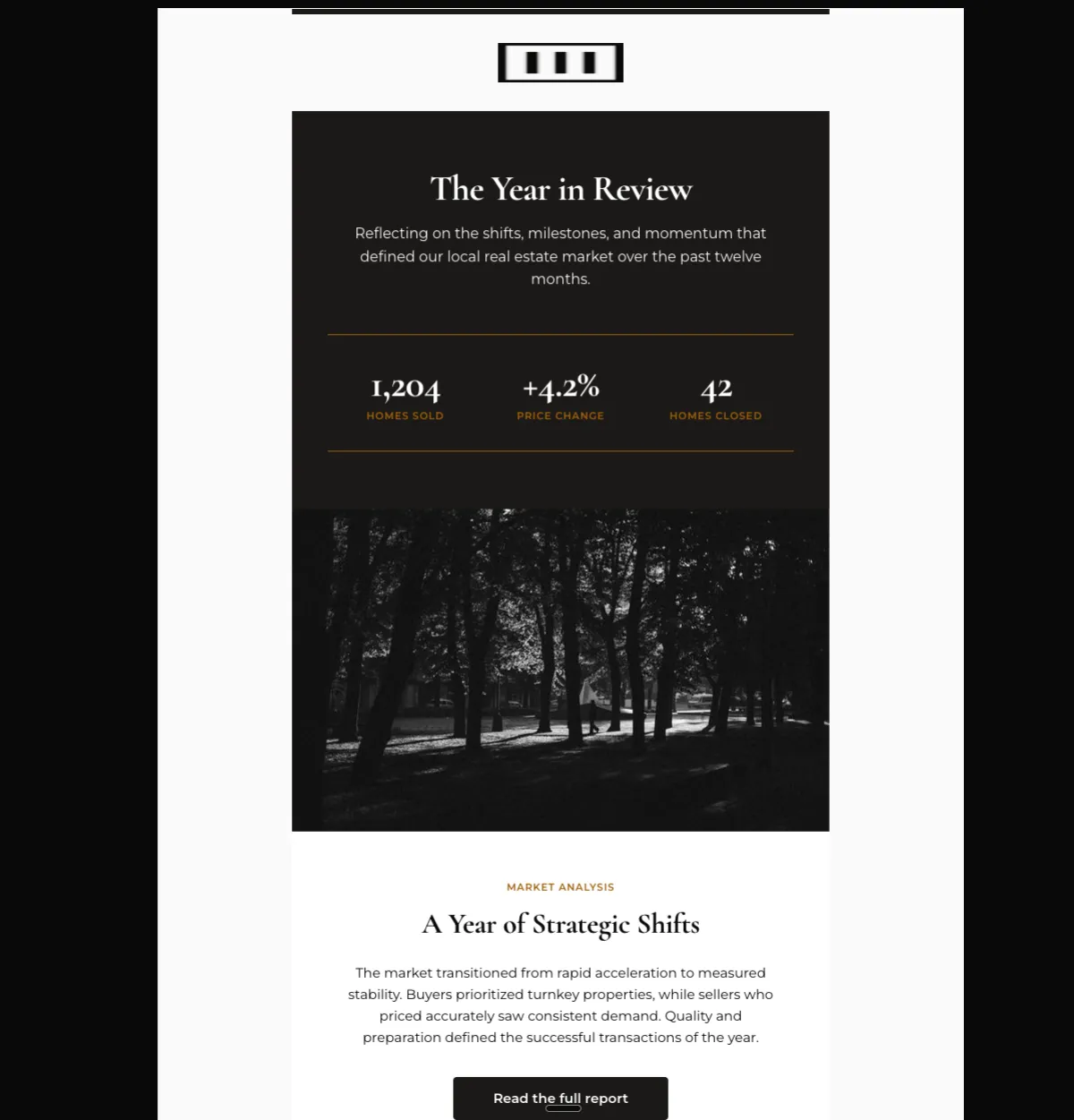
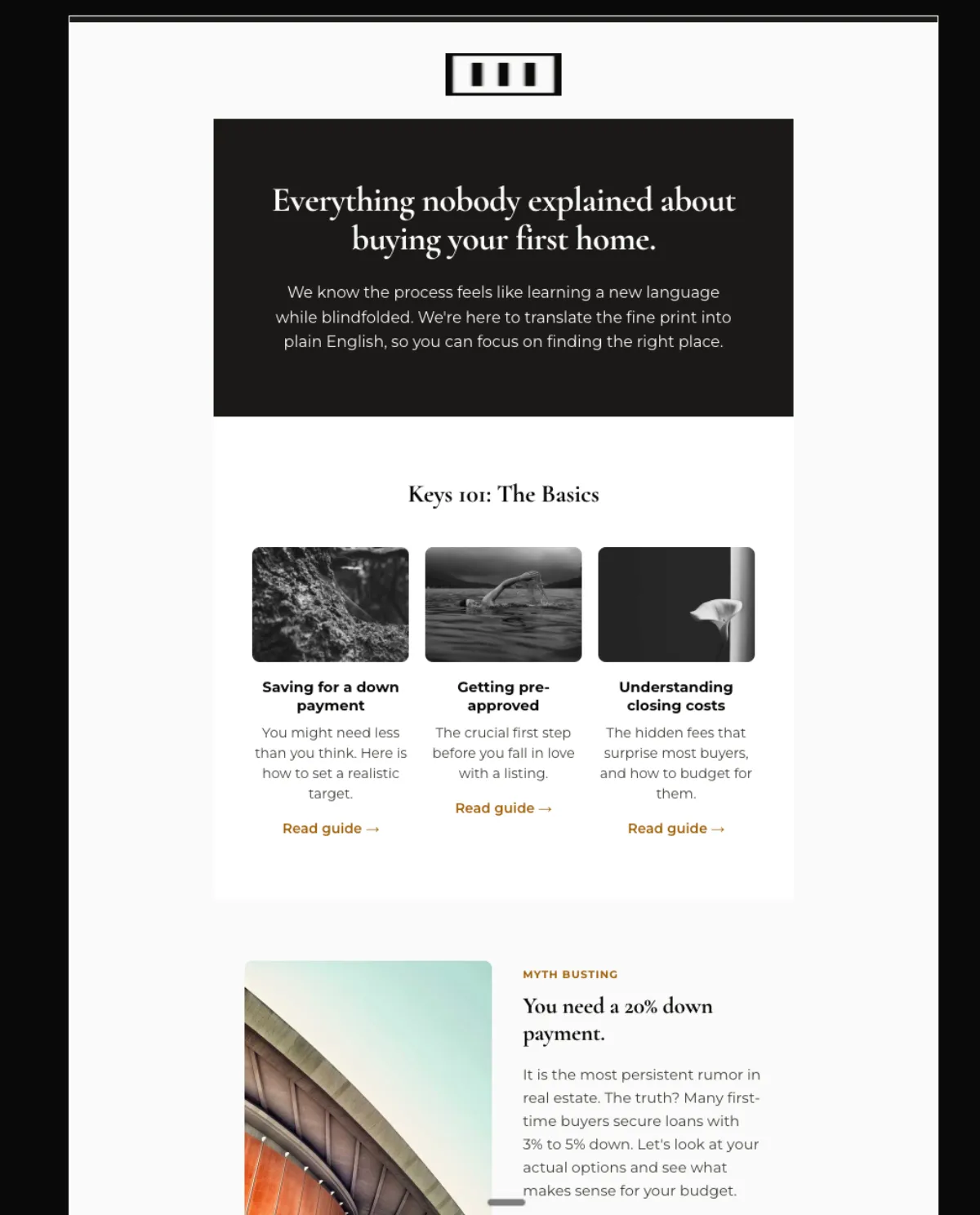
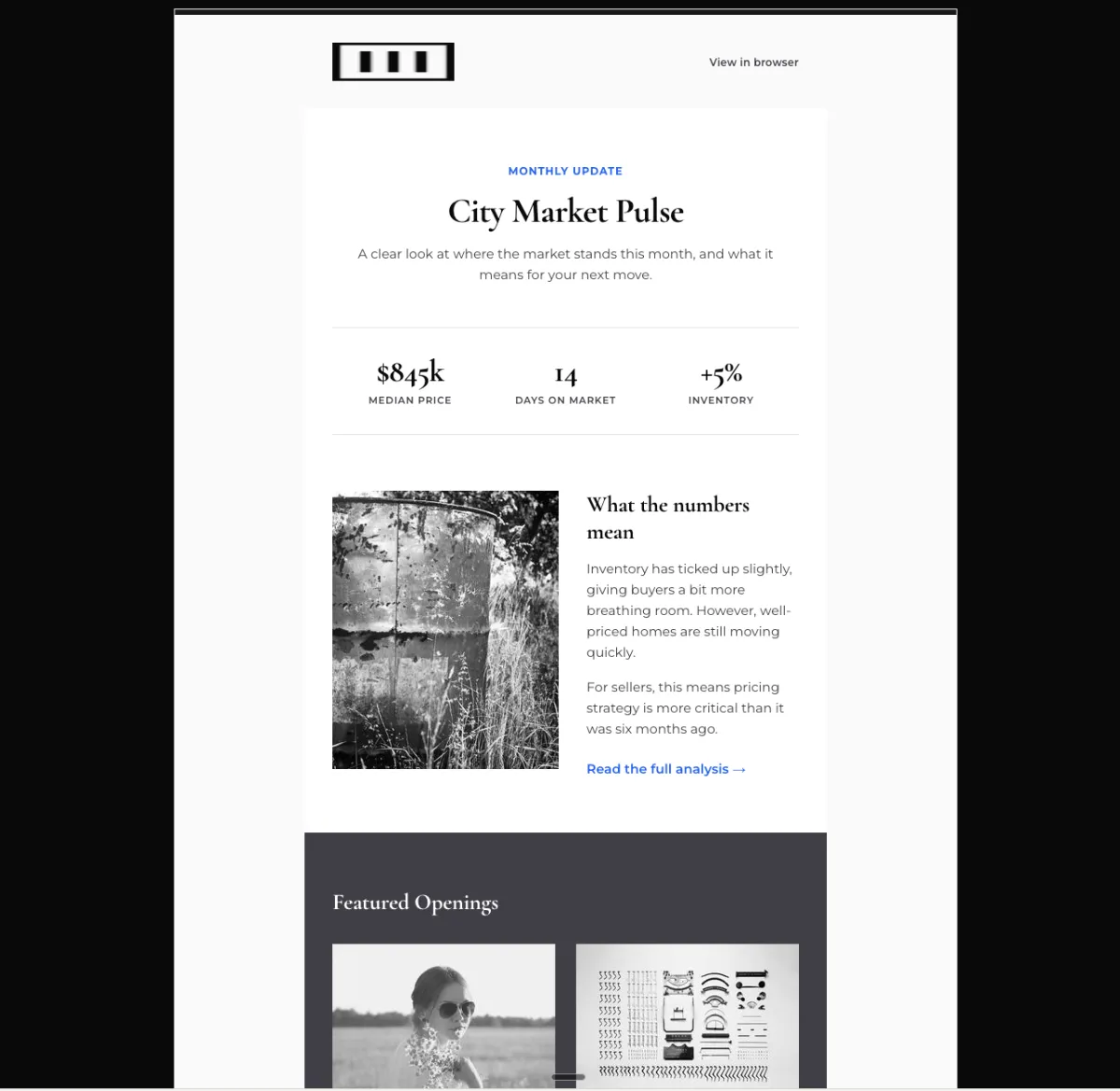
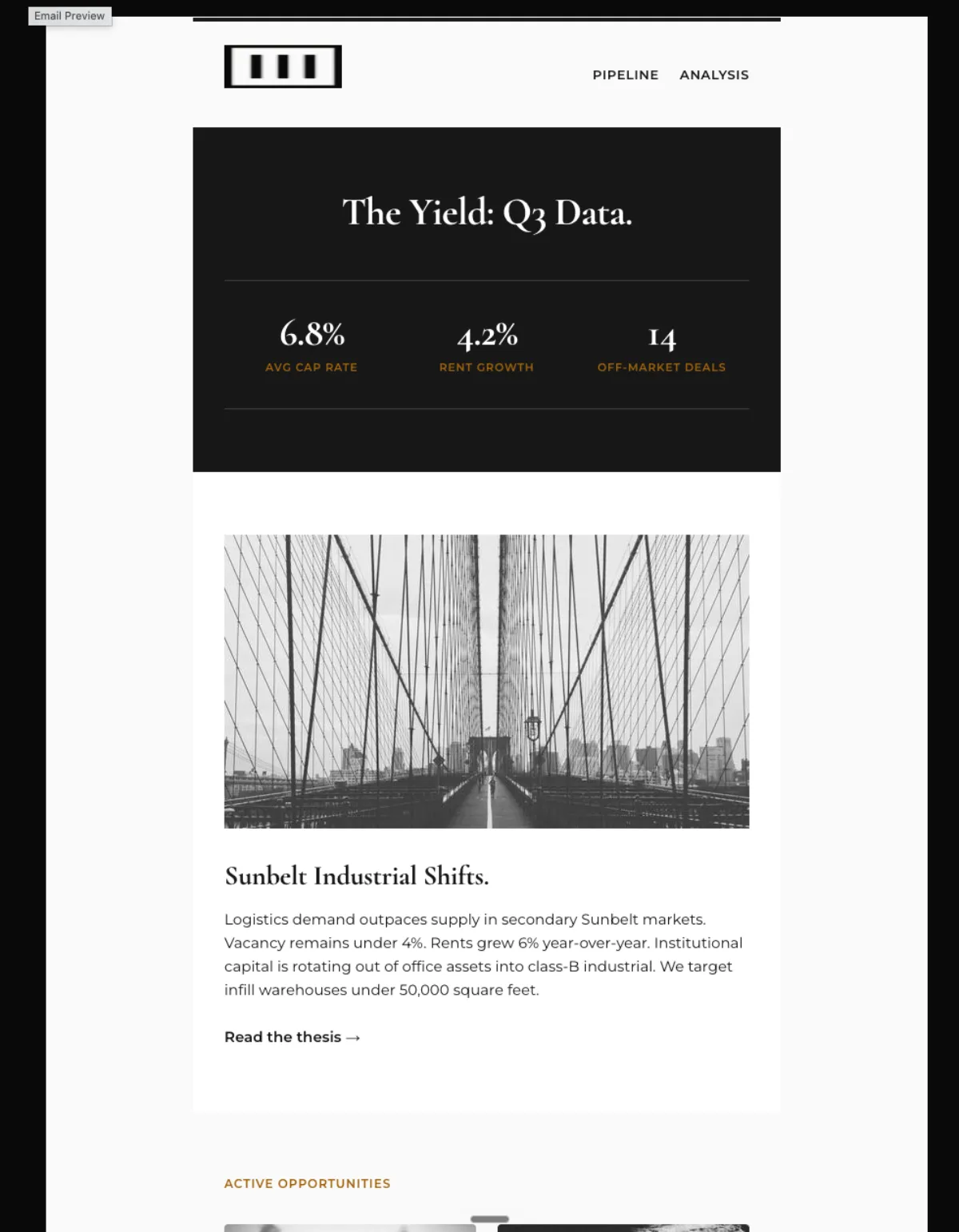
Arrow-links, not button soup
Each editorial card ends in a "Read more →" link rather than its own button. Button soup is the named failure mode of the newsletter archetype — five buttons and the reader picks none.
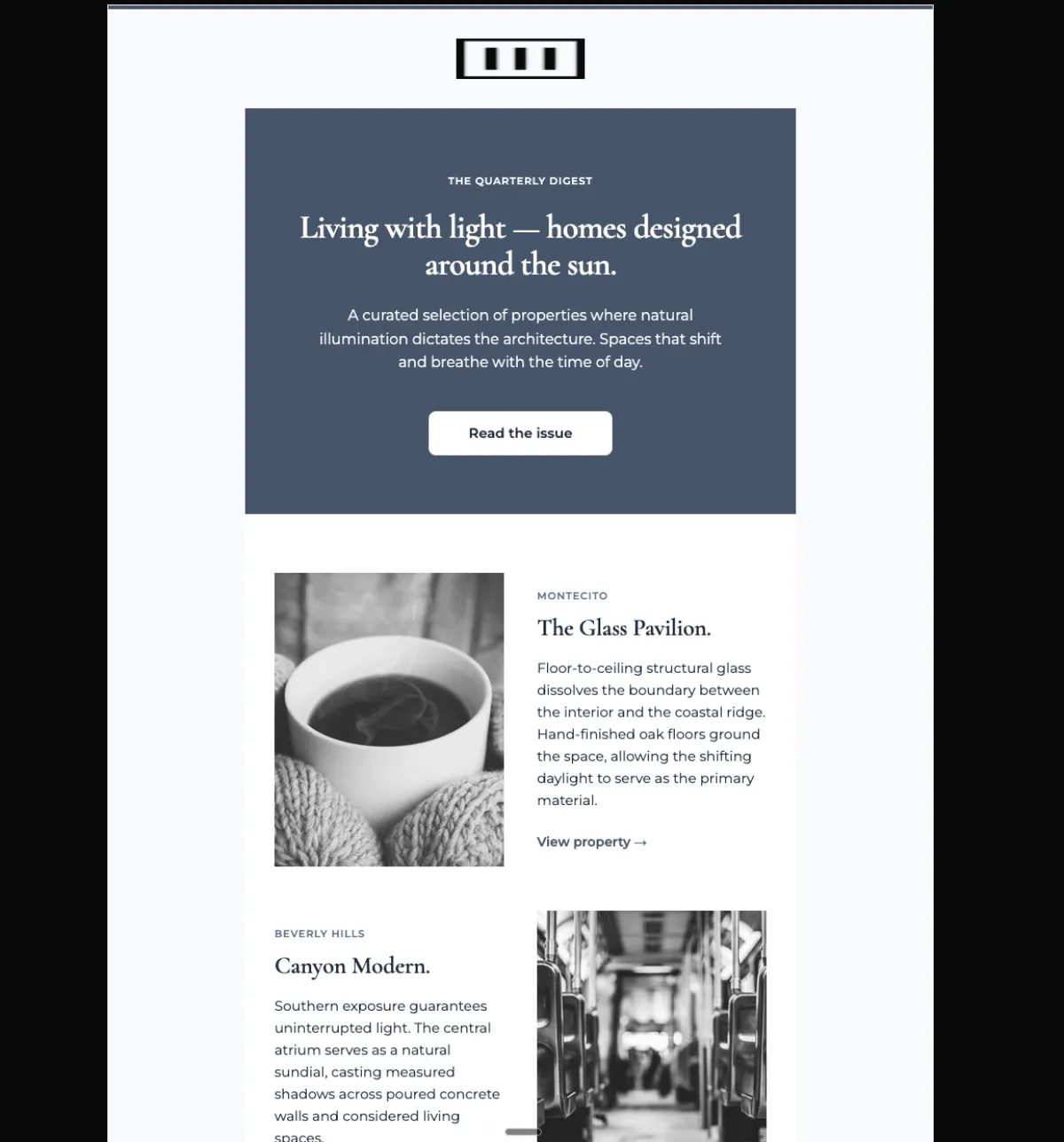
Preview
What's inside
Read off the file itself, not a spec sheet. This is the module order the download actually ships with, in the order a reader meets them.
Import
The download is a single HTML file. Here is where it goes in Mailchimp, what the platform expects, and which tags are already wired up.
Plan Custom-coded templates are a paid-plan feature. Mailchimp’s free tier does not offer the code-your-own path.
Editing This is a Classic template. Every region marked mc:edit opens in the campaign builder as an editable region with a WYSIWYG toolbar, so a non-technical teammate can change copy and images without touching HTML. Classic and the Drag-and-Drop builder are not interchangeable — an imported HTML template always lands in Classic.
Watch for Do not paste this into the Drag-and-Drop builder. There is no path from custom HTML into a Drag-and-Drop template — importing as code-your-own always yields a Classic template, which is what the mc: regions are built for.
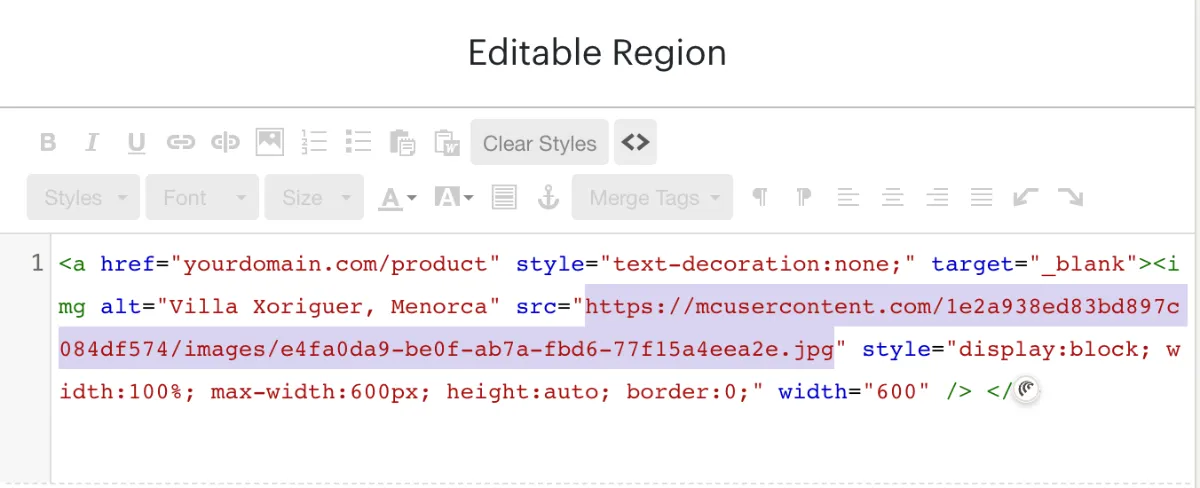
A custom-HTML template opens in Mailchimp’s legacy builder. Click the image, open the source view on that editable region, and replace the src with an image from your Mailchimp file manager — those URLs start with mcusercontent.com. The rest of the block can stay as it is.
Shortcut You can skip this entirely. Connect Mailchimp under Connectors in the studio and EmailTemple transfers the files over the API when it pushes the template, so there is no source code to edit. Connectors are on the Starter and Pro plans.
How to use it
Four sends a year, run as a campaign. Pick a fixed point in each quarter and never move off it. A quarterly digest that arrives on schedule becomes something readers look for. One that drifts is just another email. Watch the click rate on the listing links rather than the open rate — Apple Mail Privacy Protection inflates opens across every list and tells you nothing about whether the properties held anyone’s attention.
Both listing modules share the same Mailchimp editable region names. listing_title_1, listing_desc_1 and listing_image_1 each appear twice, so a colleague editing the second property in Mailchimp will overwrite the first. Rename the second set in the HTML before you hand this to a team. Then the copy. Montecito’s “The Glass Pavilion.” and Beverly Hills’ “Canyon Modern.” are writing samples, not your inventory, and the same goes for the featured estate. Three photo slots carry the whole issue and the layout is image-led, so weak photography sinks it. Repoint “Explore the estate”, then fix the footer business name and licence line.
The craft
Each editorial card ends in a "Read more →" link rather than its own button. Button soup is the named failure mode of the newsletter archetype — five buttons and the reader picks none.
One reading path, scannable blocks, alternating image-left and image-right between consecutive cards so the eye keeps moving without the layout repeating itself.
A fixed section order and a consistent send time turn a newsletter into something a reader can locate instantly, issue after issue. Morning Brew built a daily habit on exactly that predictability.
Or refine this
Generate your own with this template as a starting point. Change the colors, the voice, the offer — describe what you want different and the studio recomposes it. Apply your brand kit and ship in your tone, not the template's.
The download is yours either way.
Open this template in the studio →
Questions
No. The code-your-own path is a paid-plan feature — Mailchimp’s free tier does not expose custom-coded templates. Everything else about this template is free and unrestricted.
Yes, for the regions marked editable. Each mc:edit region opens in the campaign builder with a WYSIWYG toolbar, so copy and images can change per send while the layout stays fixed.
Consistency beats any theoretical best hour. Pick a slot your audience already reads in, then hold it — the predictability is the point. Read your ESP reports to find it, and judge by clicks rather than opens, because Apple Mail Privacy Protection inflates open rates industry-wide.
Backgrounds are set with inline styles rather than the belt-and-braces bgcolor pairing, so check the render in a dark-mode client before your first send.
The “Read the issue” button is a bulletproof VML button, so Outlook on Windows draws a real filled button instead of collapsing it to a bare text link.
The layout is a 600px table backbone with a mobile breakpoint, and the CSS is already inlined for the clients that strip style blocks.
In the studio
Describe what you want to send. Get a high-converting, dark-mode-safe template in seconds. Free tier, three generations a month, no card required.