Introduction
If you’re wondering whether Claude can replace an email marketer, you’re probably already sitting on the real asset: a warm list, an offer that sells, and nobody consistently sending. That’s the pattern behind a lot of small businesses stuck between “we have a list” and “we run an email program,” and it’s why the honest answer from the market is partly. The community is split because Claude can already cover a meaningful chunk of Claude email marketing work, but the whole role is bigger than writing copy fast.
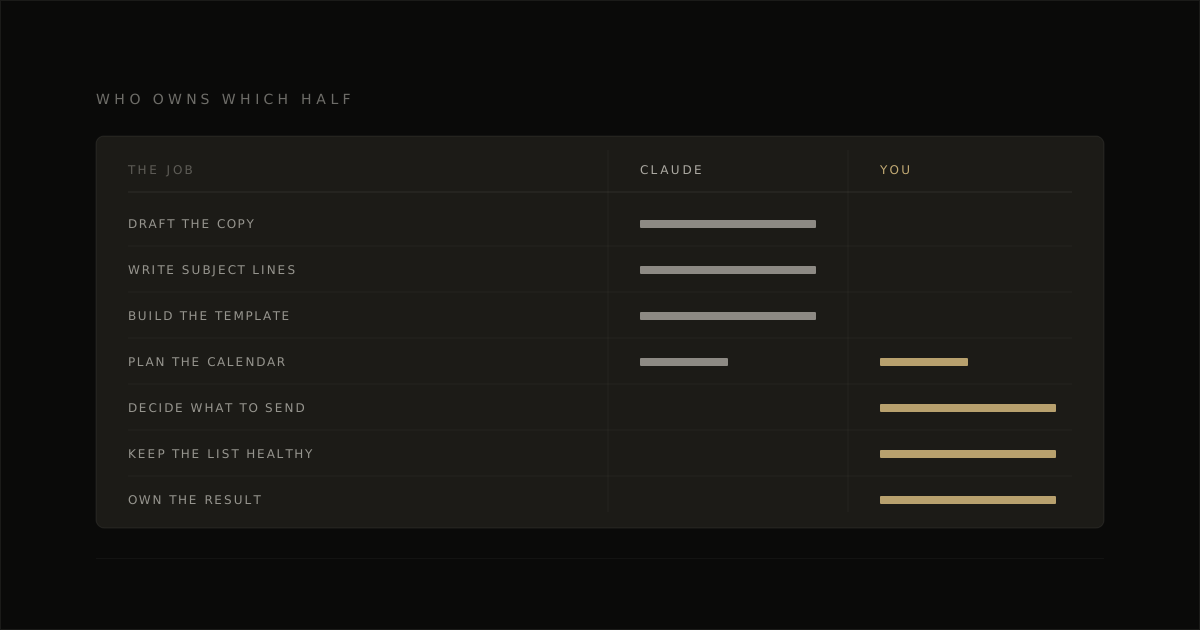
An email marketer usually brings three things to the table: strategy, execution, and accountability. Strategy is what gets sent and why, execution is turning the idea into an actual campaign or flow, and accountability is the person or system that makes sure email happens next week too. So the real question isn’t whether Claude is smart, it’s which of those three jobs you can hand over cleanly and which ones still need an owner.
Can Claude Replace an Email Marketer? The Short Answer
Claude can handle the writing and, paired with the right tool, the design, but it cannot own the strategy or the accountability.
An email marketer covers three jobs: strategy, execution, and accountability. Claude, plus a tool like EmailTemple, can cover a lot of execution and part of the email marketing strategy at software prices, which makes it a strong fit for small businesses that already have offers and a list but need to start sending consistently.
So the practical comparison usually isn’t AI versus hiring a full-time email marketer. It’s AI versus doing nothing, or versus another month of half-finished drafts sitting inside your ESP. In that situation, Claude can write marketing emails fast, help shape campaigns, and get more sends out the door. But the part that moves revenue over time is still owned by a person: someone who notices a send slipped, protects list health, and keeps pushing the channel forward.
What the Community Actually Says
The split is real: plenty of small operators think AI email marketing is already good enough for day-to-day sends, and plenty think it still needs a human hand to make the email feel considered. That tension shows up most clearly once you separate the writing from the actual campaign build.
The case that AI is already good enough
For a lot of owners, Claude already clears the bar because it can produce most of a promo or lifecycle email in seconds, which makes the old choice between hiring an agency and using AI feel practical rather than theoretical. If your choice is between sending two rough campaigns this month or sending none while you wait on an agency that costs thousands a month, AI looks like a very rational operator tool. That view gets stronger when the business already knows its offer, its segment, and the basic email it wants to send, because Claude can get the copy most of the way there fast even when the campaign setup still happens by hand.
The case that AI emails read as generic
The pushback is just as consistent: generic AI emails still read like generic AI emails when the prompt is vague, the brand voice lives in someone’s head, and the template changes a little every time. People using Claude heavily for email keep describing the same pattern in 2026: the words can come quickly, but the actual campaign, layout, and send process still need manual work, and generic AI emails usually trace back to a thin brief more than to the model itself. The stronger workflow is a repeatable system with a brand document, clear constraints, and a checkable template, because in AI email marketing the brief quality decides whether the result feels ready to send or easy to ignore.
The Three Jobs an Email Marketer Does
An email marketer’s job splits into three separate pieces: deciding the send, producing the send, and owning the send actually going out. That split is what makes the Claude question easier to answer, because software is strong in one lane, useful in another, and absent in the third.
Strategy: who gets what, and when
Email marketing strategy is the part that decides audience, offer, cadence, and sequence. A person sets those calls: who should receive the email, what single conversion goal it carries, how often engaged subscribers should hear from you, and how one send connects to the next. Claude can suggest angles, draft sequences, and help think through variants, but the ownership stays human because cadence is really coverage of the buying window, and that judgment depends on your list, your offer, and your engagement picture on that week. Once those human calls are set, you can still generate a whole lifecycle flow from one brief so welcome, trial, and win-back emails read as one arc.
Execution: copy, design, and getting it into the ESP
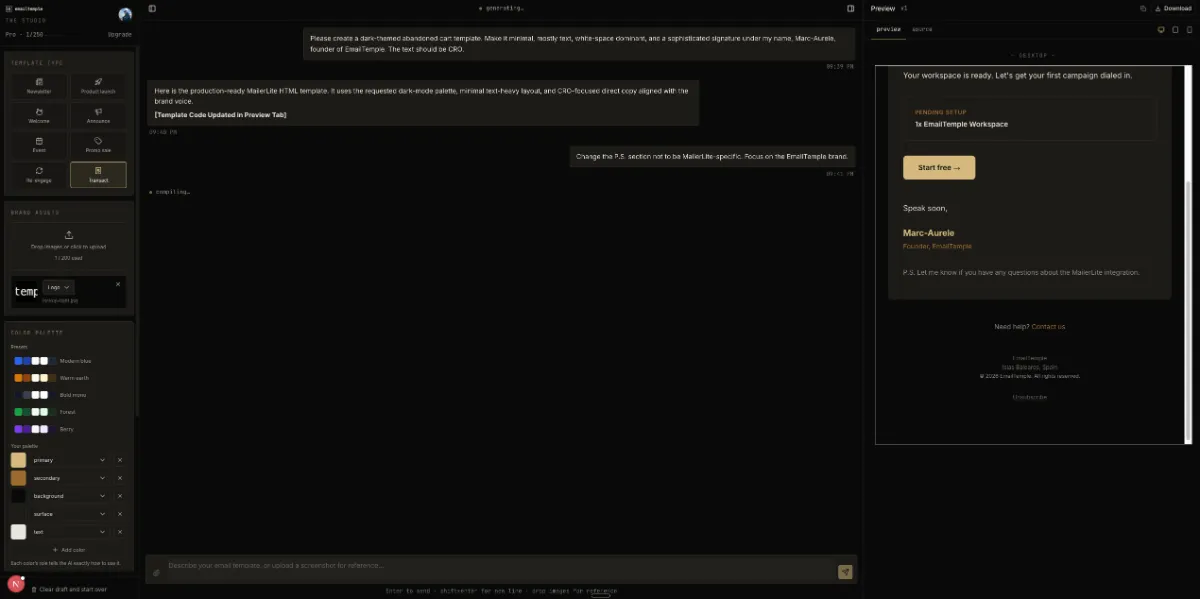
Execution is where AI is strongest, because this is the production layer: writing the draft, shaping the layout, building the email, and getting it ready for the ESP. Yes, Claude writes marketing emails well enough to save real time, and paired with the right system, it can also support AI email design so the send looks considered on mobile and in dark mode. This is where EmailTemple fits: it makes a higher cadence survivable by turning the next email into a production-ready template with one clear conversion goal, but the tool is still carrying out the brief, not deciding the brief.
Accountability: nobody chases you when a send slips
Accountability is the part software doesn’t own, because someone still has to notice the Tuesday send never happened and fix the gap. That same person reviews what went out, keeps the calendar moving, checks whether the list is still earning attention, and stays attached to the number when performance drifts. That’s why email marketing strategy shows up twice in practice: once when the plan is set, and again when a real operator keeps it alive week after week.
What You Can Hand to Claude Today
Claude can cover the writing layer today, and an email-built tool covers the production layer that turns that draft into something you can actually use in a live campaign. That line matters because email work splits fast: copy is one task, client-safe HTML is another, and the ESP still handles the send.
The table below shows the handoff point between Claude alone and Claude plus an email-built setup for AI email design.
| Capability | Claude alone | Claude plus an email-built tool (EmailTemple) |
|---|---|---|
| Write subject lines | Yes, strong draft starting point | Yes, with production workflow around it |
| Write body copy | Yes, Claude writes marketing emails well | Yes, inside a campaign build process |
| Apply brand voice | Works best with detailed prompting and examples | Built into a branded template workflow |
| Produce production-ready HTML | Draft HTML only | Production-ready template export |
| Render safely in Outlook | Inconsistent, Outlook issues are common | Built for Outlook-safe email structure |
| Dark-mode safe output | Varies by prompt and code output | Built for dark-mode email clients |
| Export to your ESP | Manual handoff | Yes, export or draft push into the ESP |
Where a general model stops
A general model stops at draft quality. Claude email marketing is useful when you need angles, subject lines, body copy, rewrites, and variations fast, but that still leaves the production step sitting on your desk.
The HTML gap is real. In Knak’s April 2026 study, 8 of 9 AI-generated emails had at least one Outlook rendering issue, and none of the 9 outputs were production-ready, which is exactly why generic prompting tends to break once layout, fonts, buttons, and Outlook handling matter.
Where a tool built for email picks up
A tool built for email picks up where the draft has to become a sendable asset. That means the output is structured as a production-ready template, built for Outlook handling, built for dark mode, and ready to move into the platform that actually schedules the campaign.
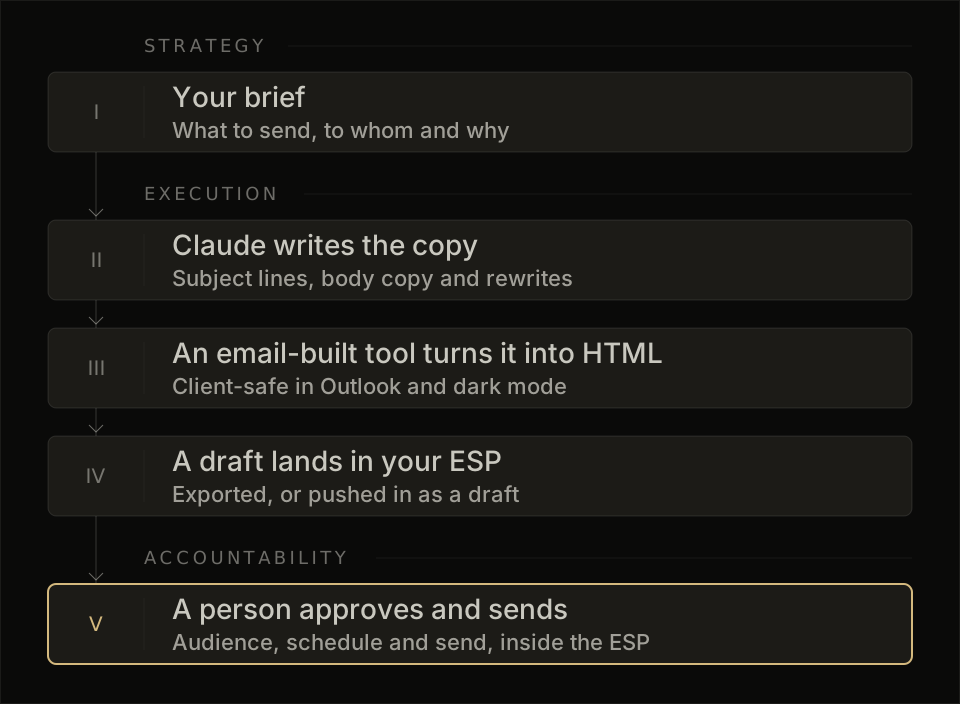
The final handoff still sits in your ESP. EmailTemple generates the campaign and exports it, or creates drafts inside the ESP, and the ESP is where the audience, schedule, and send get approved.
The Parts No Model Owns: Deliverability and List Health
A great email still fails when it misses the inbox, and that’s where the accountability gap gets real. Deliverability usually breaks in one of two separate places: list quality and engagement, or authentication through SPF, DKIM, and DMARC. The fast read is simple: a gradual drop across several campaigns usually points to list fatigue, weak engagement, or over-sending, while a sudden drop after changing a sending domain, from-address, or ESP points to authentication first.
Claude can help produce copy, and a design tool can help produce cleaner HTML, but neither one is watching sender reputation or deciding which segments have stopped earning the right to be mailed. That work sits inside email marketing strategy and day-to-day ownership: list hygiene, sending volume, authentication, and reputation all live with the sender and ESP. A studio like EmailTemple helps on the content side by producing lightweight HTML, visible unsubscribe and preferences links, alt text, and image use that stays readable to filters and people alike. For the deeper process, see How to Improve Email Deliverability: The Staged Repair Playbook.
How to Decide: AI, an Agency, or Neither
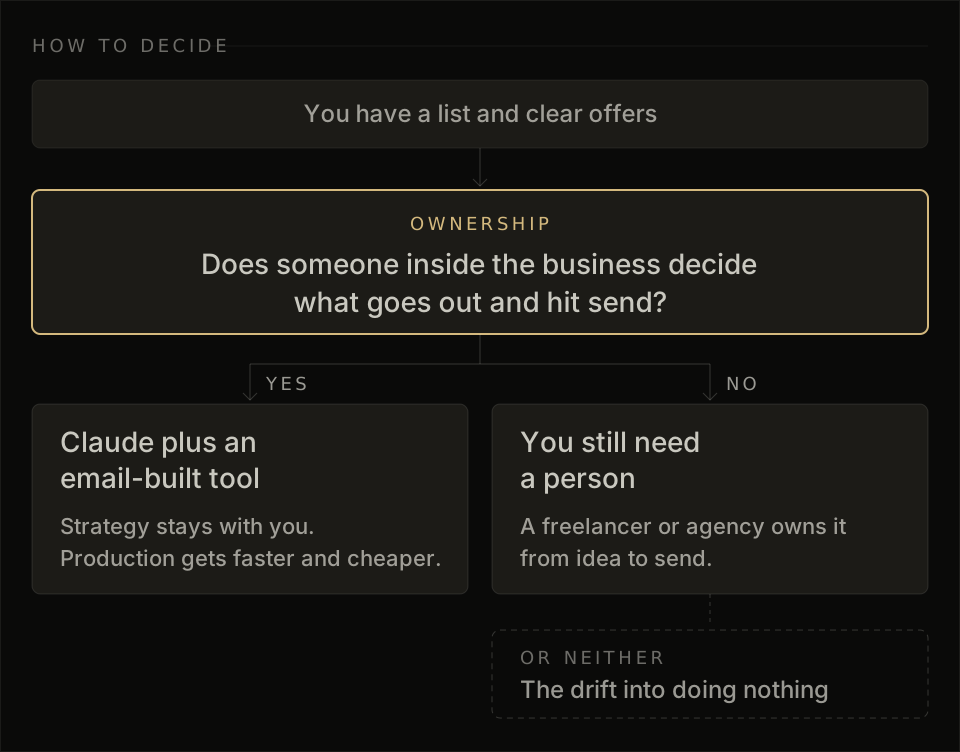
This decision gets simple once you separate the work from the owner. If you have a list, clear offers, and someone inside the business who can decide what goes out and hit send, Claude plus an email-built tool is usually enough for the execution side, and the agency versus AI question lands in AI’s favor for a lot of small operators. That matches what shows up in the market now: plenty of owners see AI as good enough for most of an email, and the active alternative is often a freelancer or agency workflow that adds cost, handoffs, and wait time. In that setup, your email marketing strategy still lives with you, while the production layer gets faster and cheaper. EmailTemple fits that execution half: you describe the send, and the template comes back ready for your ESP.
When Claude plus a tool is enough
Claude plus a tool is enough when the business already knows what it wants to send and just needs the email marketer’s job reduced to production. That usually means a founder, operator, or marketer already owns the calendar, the offers, and the audience, so the real choice is between an agency and AI for copy and build work, not for direction. In that case, software prices make sense, the workflow stays close to the business, and you keep the judgment where it belongs: deciding the message, the segment, and the timing.
When you still need a person
You still need a person when someone has to own the full email marketing strategy from idea to send, and nobody inside the business is doing it consistently. Why? Because the gap is usually ownership, not typing speed. A person earns their keep when they choose the campaigns, keep the cadence moving, connect the channel to launches and promos, and carry the accountability that a model cannot. And in real life, that choice is often less about hiring an agency at thousands per month and more about whether the business will actively run email at all, because doing nothing is the path a lot of owners actually drift into.
Where This Leaves You
Claude replaces a big chunk of the execution work and part of the planning work, but the owner still matters because someone has to decide the send, approve the message, and keep the calendar moving inside the ESP. For most small operators, that makes the real choice much simpler: Claude email marketing is often competing with inconsistent sending, not with a full in-house email marketer.
So if your list is warm, your offers are clear, and the blocker is that your templates look cheap every time you open the editor, fix the production layer first. Generate your branded template for free if you want AI email design that starts from a simple prompt and comes back as a production-ready, dark-mode-safe template exported to your ESP.
Frequently Asked Questions
Can Claude send marketing emails on its own?
Claude can send email through inbox connectors, and some ESP connectors expose send actions. For marketing campaigns, the safer operating pattern is simple: Claude drafts, the ESP sends, and a person approves the audience and the send inside the ESP.
That matters because campaign sends carry consent, unsubscribe, and audience-selection obligations. In practice, experienced operators keep connectors on draft duty, then verify the segment in plain English before anything goes out.
Is Claude or ChatGPT better for email marketing?
For copy, both are capable, and the brief usually decides the quality more than the model. For email, the real split is between writing assistance and campaign ownership, because neither model owns the strategy or the accountability.
For HTML, the evidence supports a more careful answer. Claude has been evaluated for email HTML and can produce decent table-based output, but it still mixes merge-tag dialects and misses compliance details unless something checks it, and there is not equivalent like-for-like testing here to call a clean winner over ChatGPT.
Will AI-generated emails hurt my deliverability?
AI-generated emails can affect deliverability when the copy reads generic, the targeting is loose, or the send comes from a list with weak engagement. Deliverability still lives in sender reputation, authentication, and list health, and no general model is watching those moving parts for you.
So yes, Claude can write marketing emails, but the inbox result still depends on the ESP setup and the quality of the audience selection. A human review before sending is what keeps the copy, segment, and reputation aligned.
Can Claude generate production-ready HTML email templates?
Claude can generate HTML email drafts, and they often need a repair and QA layer before they are ready for a live campaign. Outlook is where the gap shows up fastest, because email HTML still depends on old rendering quirks such as table structure, inline CSS, and client-specific handling.
Current testing supports using Claude for drafting and building, then validating the output inside an email-specific workflow. That is also where merge tags, dark mode behavior, and compliance details get checked before the template reaches subscribers.
Do I need a data agreement to use AI on customer emails?
If customer emails contain personal data, check whether your plan includes an appropriate data processing agreement and coverage for that workflow. Where that coverage sits on an API path, build the process there and keep the handling rules clear before you pass real customer messages into the model.
This comes up most often with drafted replies and support-style inbox work. The practical question is less about whether AI can help, and more about whether your chosen setup matches the data handling standard your business needs.